
Deciding to host an eFoil race is easier than you think, and it will do more for your riding and for your local eFoil scene than just about anything else you can do on the water. Here is everything I have learned about putting one on: why you should bother, exactly what to buy, how to time it, and how to lay out a half-mile course that riders will want to run over and over.
Why Host an eFoil Race?
A race is a great way to meet other eFoilers, a great way to promote the sport, a great way to get better, and a great way to help other people get better. Those four things happen all at once, in one afternoon, and they keep happening every time you run the course.
Competition also adds a whole new element and challenge to the sport. Free riding teaches you to turn when you feel like it. Racing teaches you to turn when you need to, which is what turns you into a proactive and reactive rider instead of a passenger. The quality of your carves will get noticeably better after just a few runs through a course. It is that fast.
Everything You Need to Host an eFoil Race Is Right Here
The Verdant Ride eFoil Racing League gives you free tools to establish your race, promote it to other eFoilers, and invite riders to your event. We also built a tool called Verdant Ride Race Marshal that keeps track of all your racers, logs their times, and automatically generates a leaderboard.
All you have to do is set the venue, set the date, and build your course. We will help you with that too. When you are ready, register your course and point your riders at the racer registration page.
Sourcing the Parts for a Great eFoil Race Course
Course Buoys
Any color works, but I prefer yellow. I use the X-Haibei Pair of Boat Fenders Ball Round Anchor Buoy, Dock Bumper Ball Inflatable Vinyl Shield Protection Marine Mooring Buoys at $37.99 for a pair. You need a minimum of four.
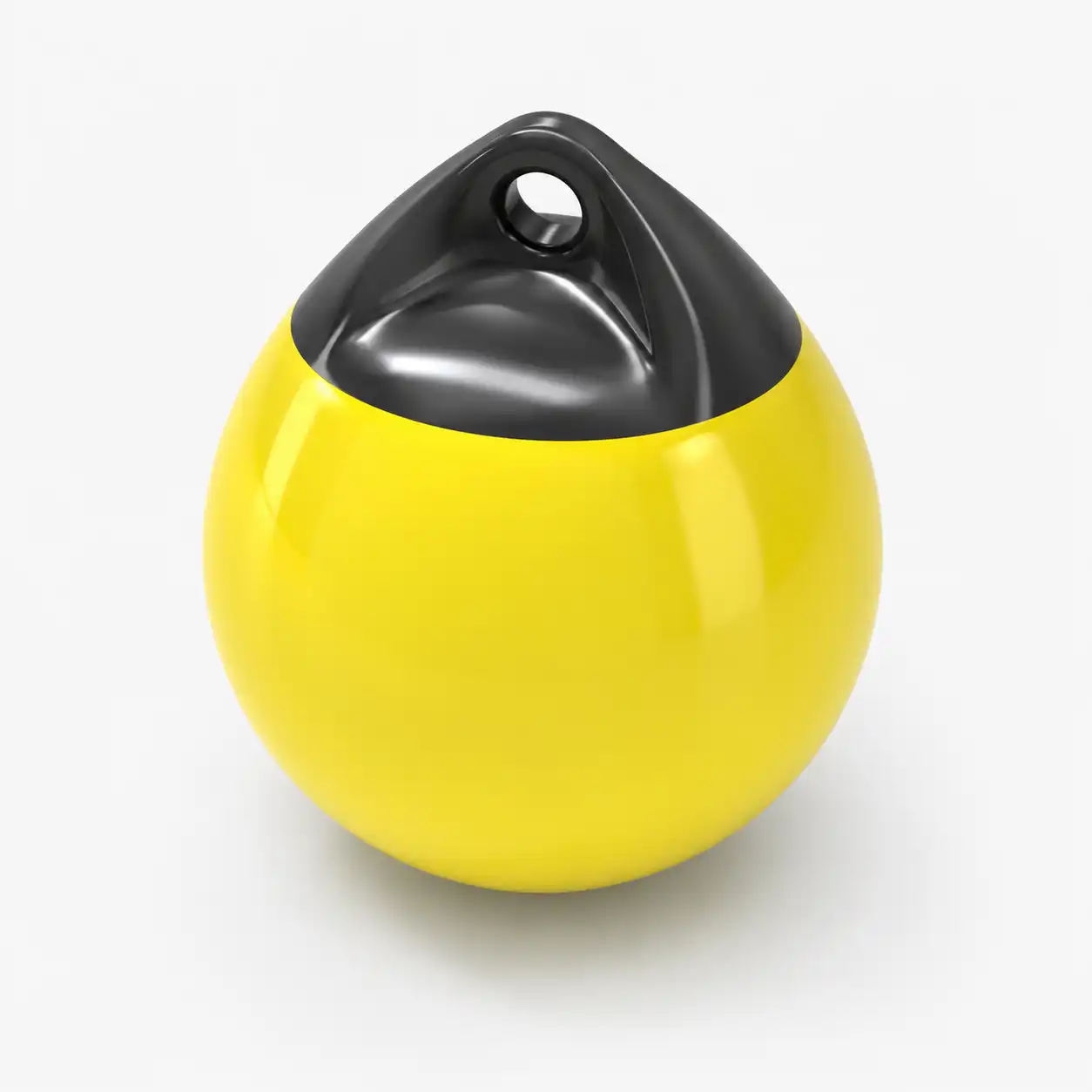
That said, let me make the argument for a double-pole course. Double poles help newer riders know which side of the mark to turn around, and they make the course more exciting to ride and to watch. A standard course sets the double-pole gates 8 feet apart. You can make your course more challenging by tightening them up: 4 feet is tight, and 10 feet is easy to line up and squeeze through. The tradeoff is that a double-pole course costs twice as many buoys and takes longer to set up and tear down.
Start and Finish Gate Buoys
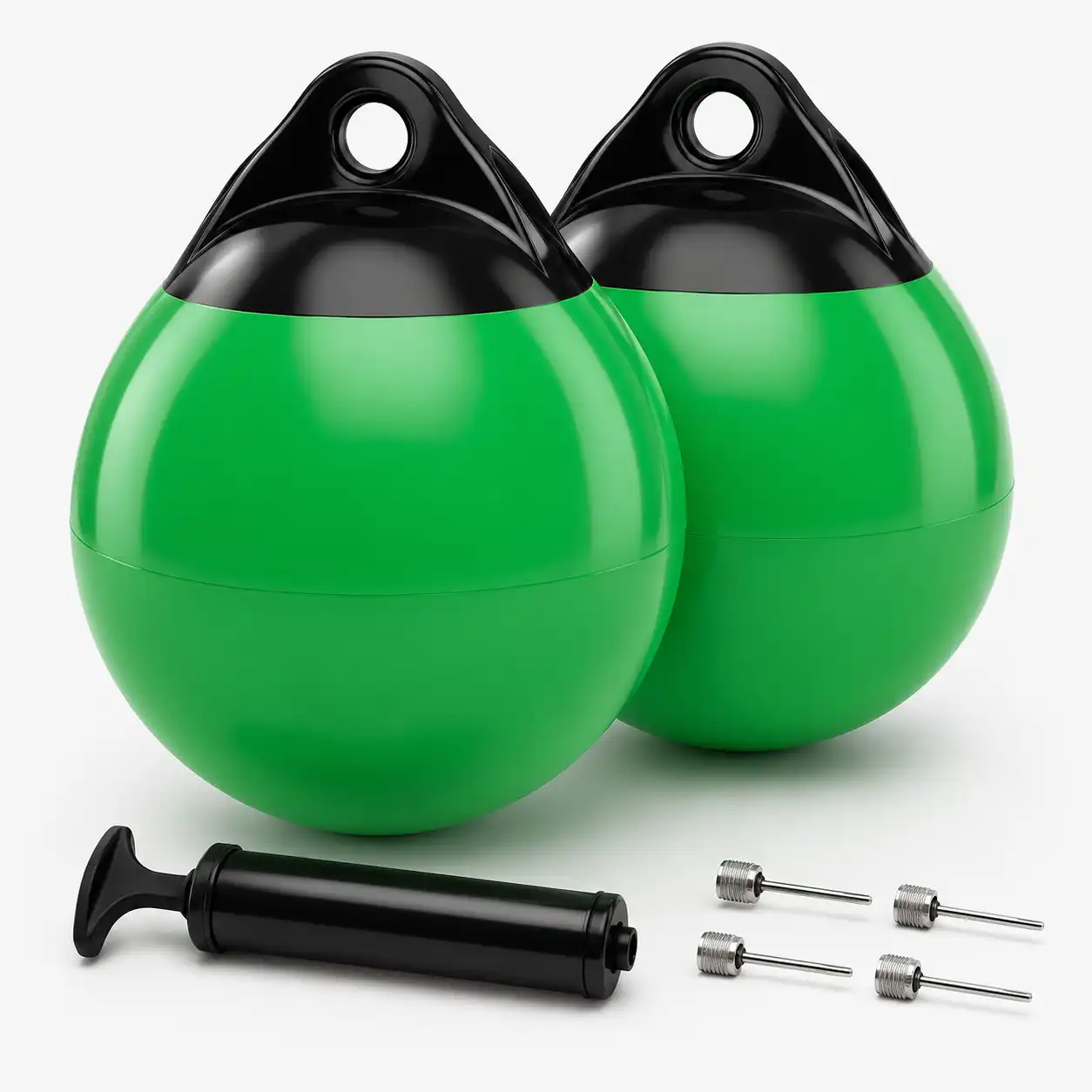
Two more buoys for the start/finish gate. Again, any color works, but I like green so the gate reads instantly from the water. I use the 15 inch Boat Buoy Balls Anchor Buoy Float Round Boat Fenders, Vinyl Inflatable Boat Mooring Buoys, Boat Buoys Bumpers for Docking/Anchoring/Marking in green, $48.99 for a 2-pack.
Anchors
Technically anything reasonably heavy will work. A cinderblock is the cheapest anchor I have found at around $2 each, but cinderblocks are miserable to lug around compared to a folding anchor system. I use the Lounsweer 1.5 lb Anchor Kit for Kayak Paddle Board, Marine Kayak Anchor Kit, Folding Grapnel Anchor Kit at $36.99 for a pair. They come with 40 feet of rope, a float, and a handy bag, which makes setup and takedown very easy. They come in just about every color imaginable, and yes, I prefer yellow.
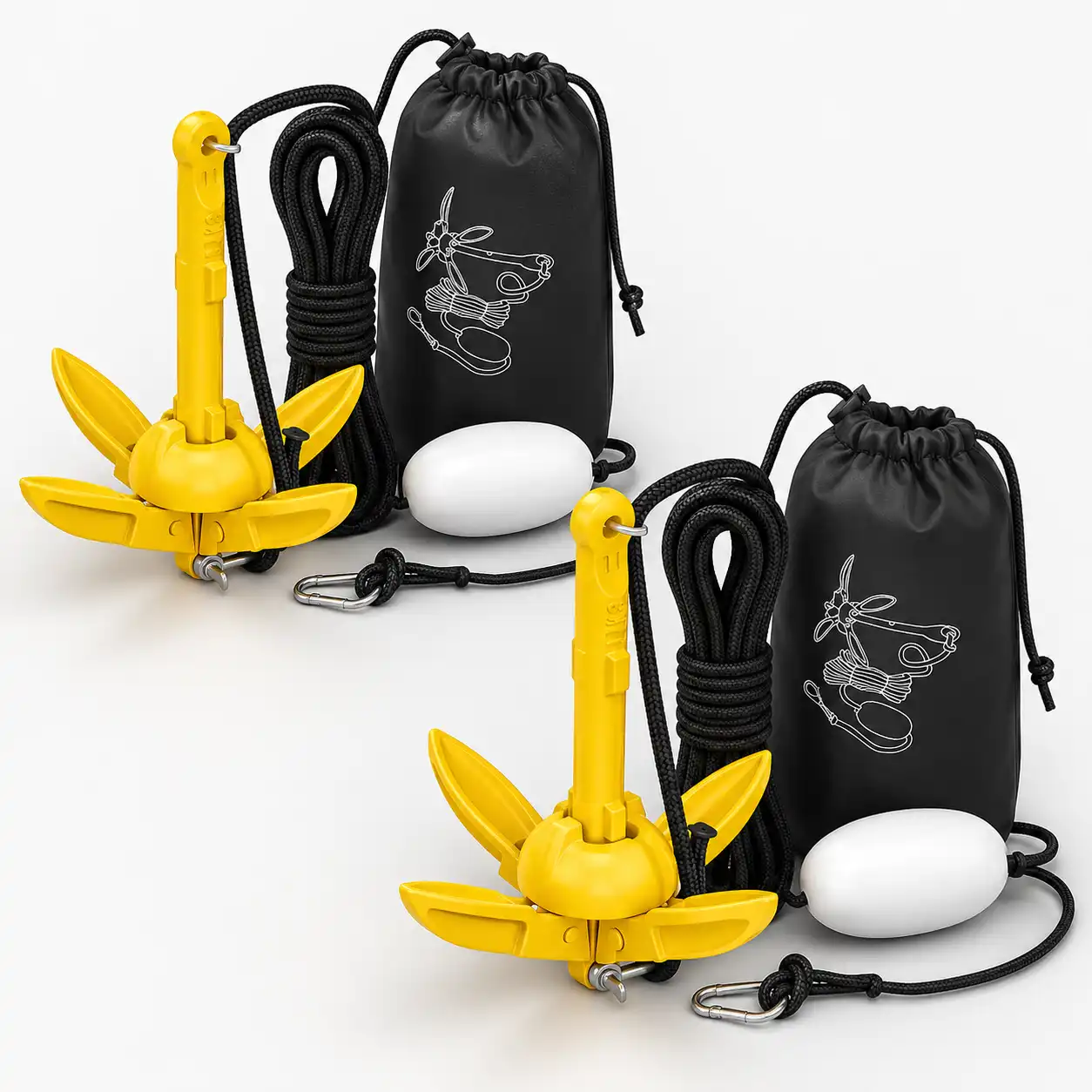
You need one anchor per buoy, so plan on a minimum of six. You will need ten if you want to build the deluxe double-pole course.
Quality of Life Upgrades That Save You Setup Time
Nothing in this section is strictly necessary, but every item on this list removes a headache and cuts down your setup time.
Make Your Buoys Self-Adjusting
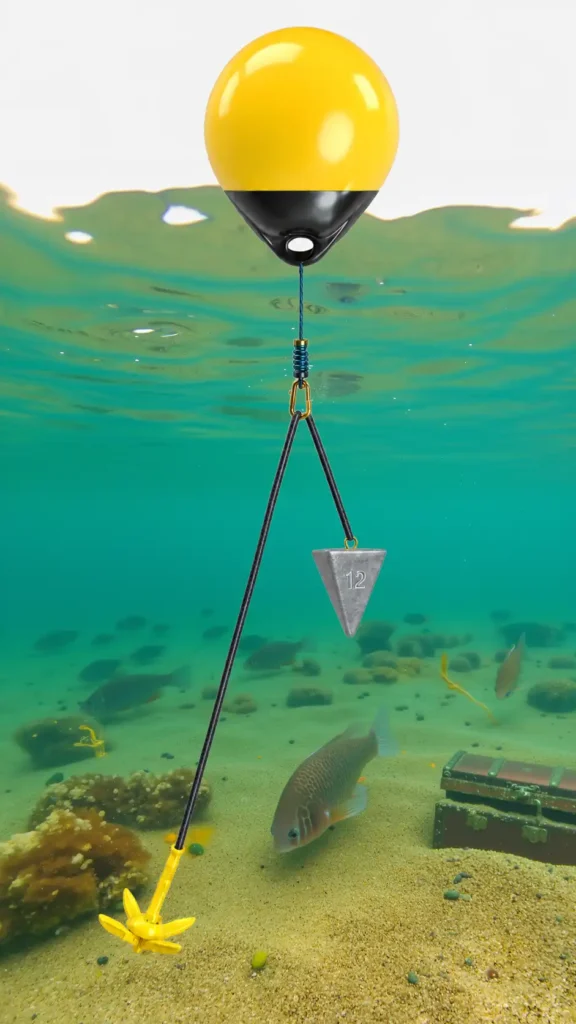
Instead of attaching your buoys directly to your anchors, use a counterweighted system. Tie one end of the anchor line to the anchor, run the line up through the hole in the buoy, and attach a 12 oz drop weight to the other end. The buoy now floats up and down with the water level and stays directly above the anchor point.
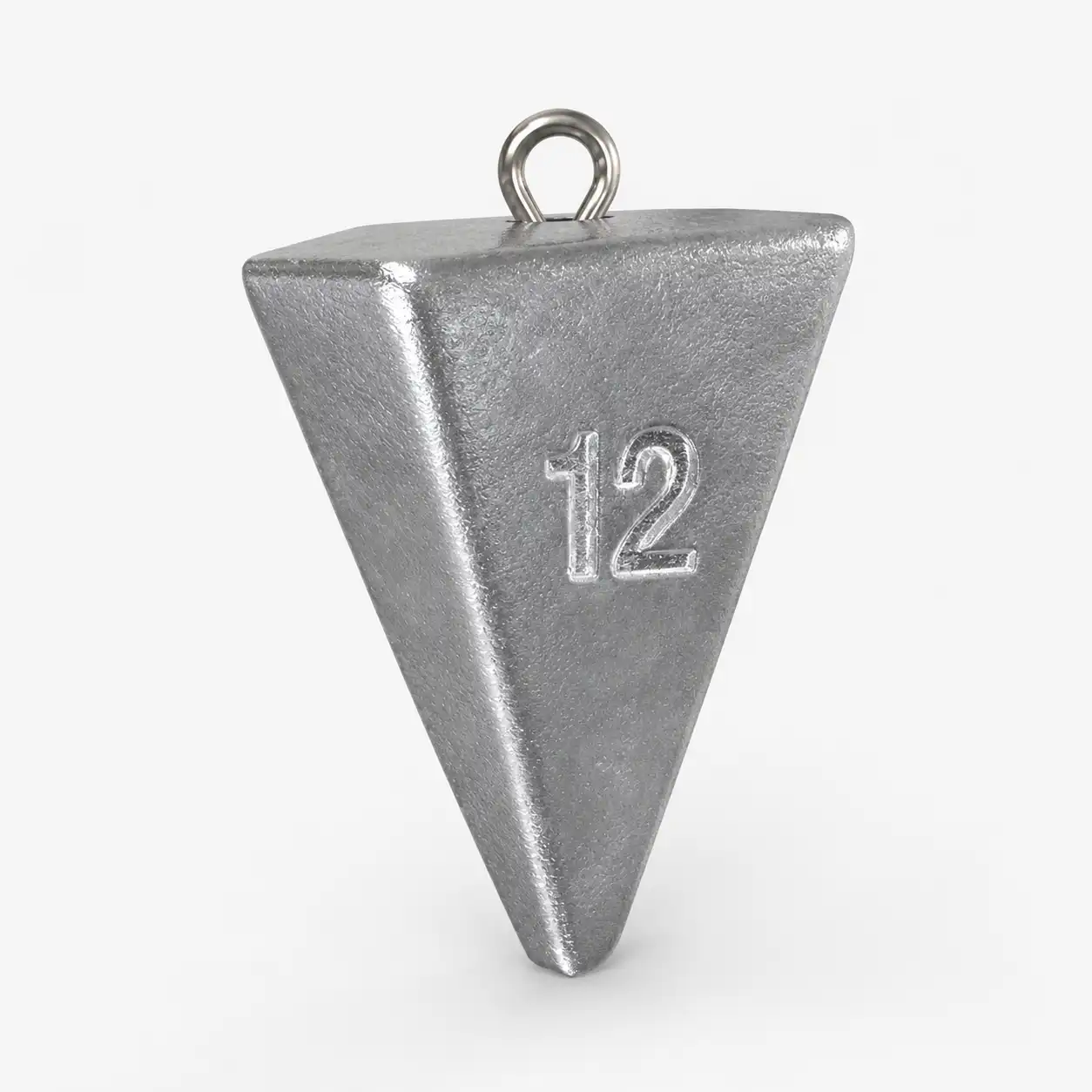
This also helps hold your gates in position in high wind, because the buoys can wander a bit in the waves and then return to their original spot once the water settles. I use BLUEWING Pyramid Sinkers Lead Fishing Weights, 12 oz, which run $28.99 for five, so one order just about covers a standard course.
Upgrade Your Rope to Something Far Better
If you plan to leave your racecourse in the water all season the way I do, you are going to want something better than rope. Rope gets disgusting after a few weeks in the water and eventually degrades. I use KALLSDY Vinyl Coated Wire Rope 3/32 inch, 400 ft, 304 Stainless Steel Cable, which comes with plenty of crimping sleeves, for $39.99.
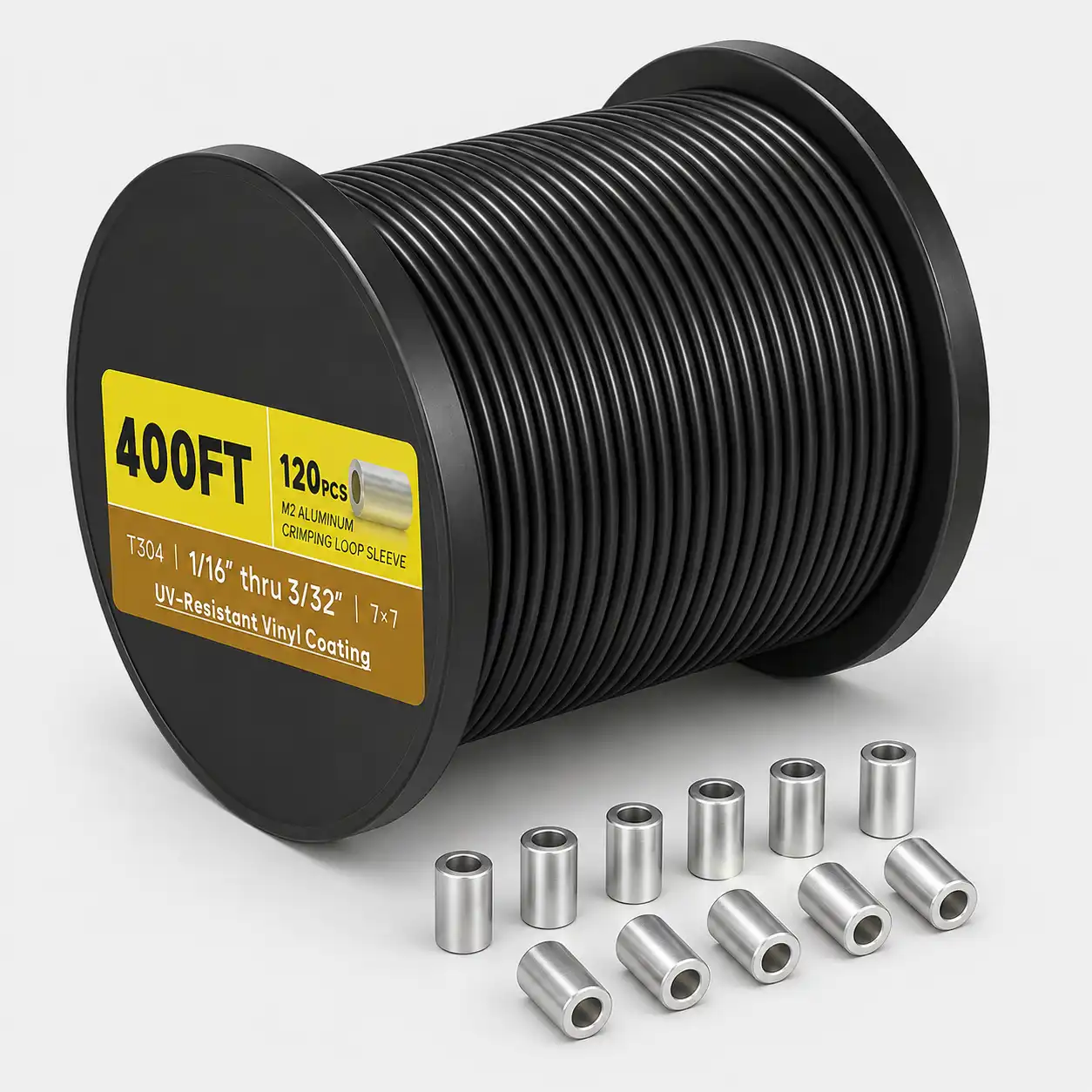
This stuff seems to last forever. I am on season two with mine, and I left a couple of lines in over the winter with no degradation or wear at all. It is also heavier than water, so if a line ever comes detached it sinks instead of drifting. That means no stray ends wrapping up in someone’s prop.
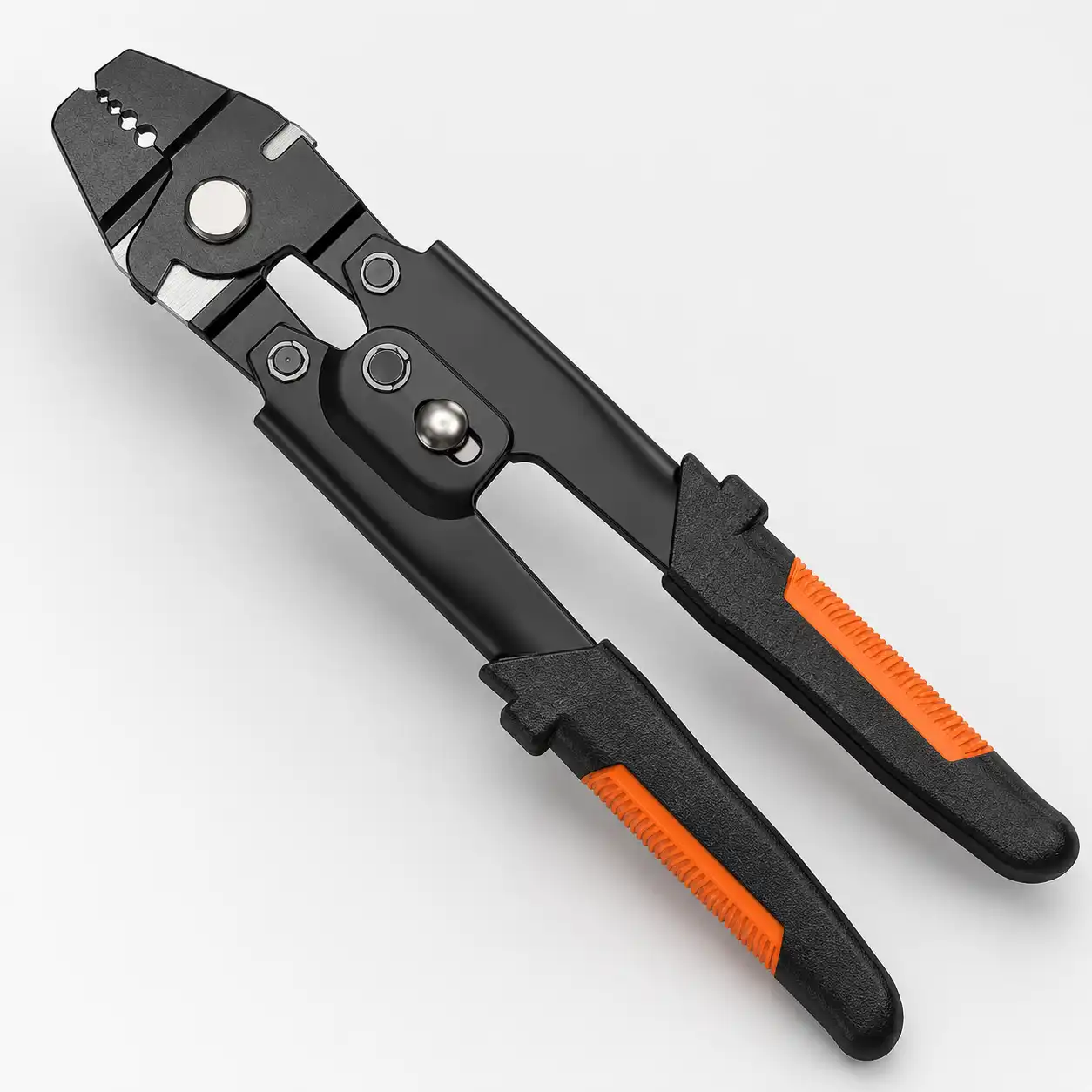
You will need special tools to cut and crimp it, plus a set of cheap spring-loaded connectors or carabiners to link everything together. The Wirefy Short Handle Wire Rope Crimping Tool, 2-in-1 Cutting and Cable Swaging, with 150 Loop Sleeves runs $18.99 and does the whole job.
Timing Your eFoil Race with Race Marshal
For timing, just use Verdant Ride’s own Race Marshal app. It is free and it handles everything for you. Load it on your phone. Every racer registered on your course is already entered, so when a rider lines up you simply hit the Racer Ready button.
Keep your phone’s camera aimed at the start/finish gate. Hit start as the racer crosses in, hit end as they cross out. The app then shows you video of both moments so you can nudge the start and end times to the exact frame where the nose of the board first broke the plane of the gate. Race times come out accurate to 1/60th of a second.
That frame-by-frame review is what makes your phone a legitimate photo finish camera. When two riders finish within a board length of each other, nobody has to argue about who got it. You scrub back through the footage inside the Verdant Ride Race Marshal app, find the frame where each nose broke the plane, and the times settle it. A 60th of a second is far finer than anyone’s eyes and thumbs, so the closest finishes of the day end up being the ones you trust the most.
To make this easy on your judges, lock your phone into a sturdy tripod aimed at the gate.
Locking In Your Phone
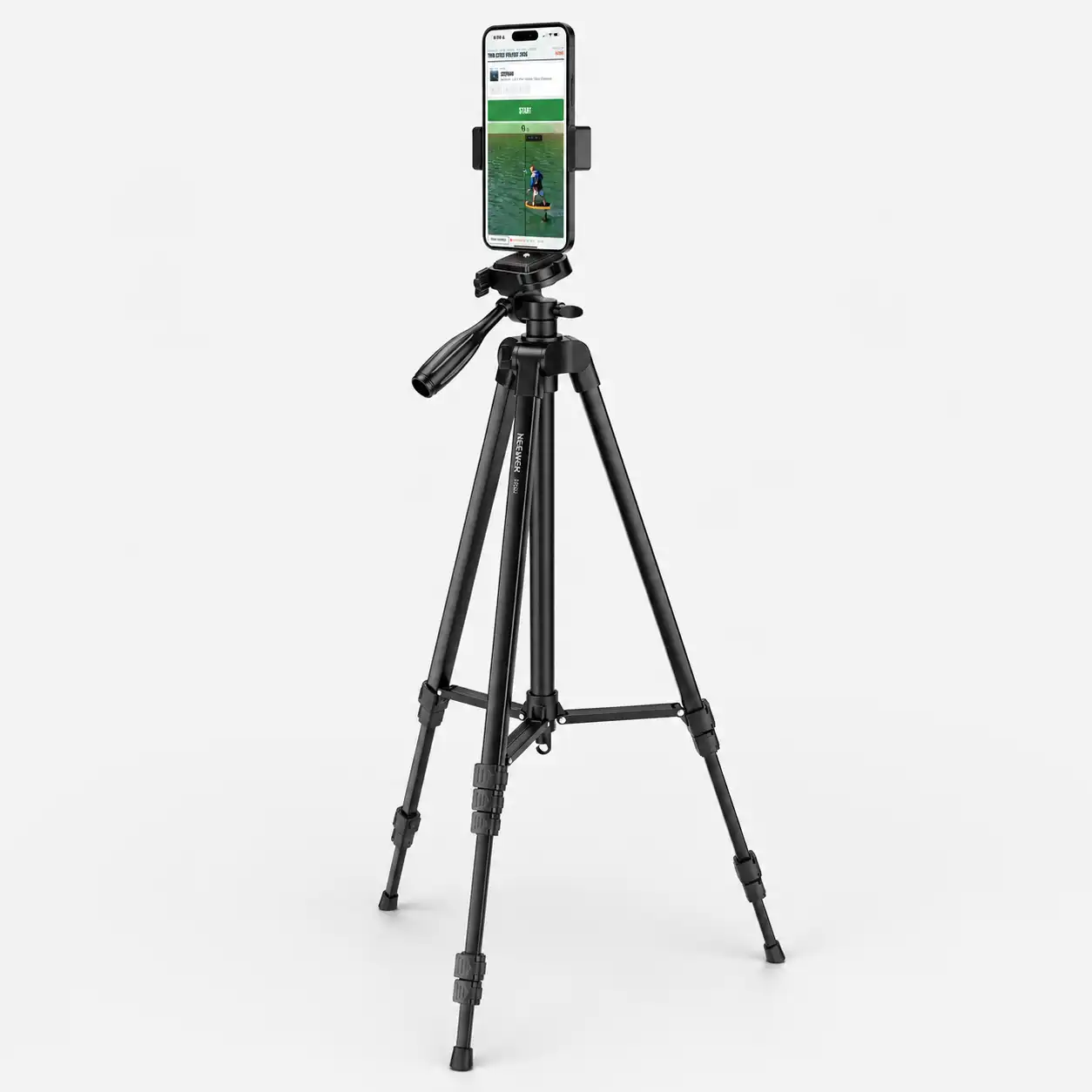
If you already own a tripod, all you need is a phone mount like the ULANZI ST-06S Phone Tripod Mount Holder, which works with hot shoe and cold shoe setups and gimbals. That is $10. If you need the whole thing, the NEEWER Entry Level Tripod for Cell Phone and Camera, TP53 is a solid lightweight option at $23.99.
If you really want to get fancy, you can connect any camera to your computer, even one with a big telephoto lens, and run the app from the website. It is complete overkill, and it is also very satisfying to work on a big screen and watch the racers and times roll in like the pros do.
The Free Tools That Run the Rest of Your Race
Race Marshal is only the timing piece. We built the whole Verdant Ride eFoil Racing League toolset to get grassroots racing off the ground, and every bit of it is free to use. You bring the water, the buoys, and the riders. The tools handle the paperwork.
Register Your Event and Promote It
Start by registering your course and event. That one form puts all of your information out where riders can actually find it. Your venue, your date, your course layout, launch instructions and driving directions all go public, and your race drops onto the league calendar so eFoilers hunting for something to do that weekend land on your event instead of scrolling past it.
From there you get a page you can share anywhere. Post it in your local group, text it to the crew, or send it to the one friend who keeps saying they will show up and never does. It is also where you assign additional marshals to the roster, so you are not the only person holding a phone all afternoon. Hand off timing duty, hand off gate duty, and actually get a few laps in yourself.
Let Riders RSVP Themselves
The racer registration and RSVP tool automates sign-ups completely. Every rider who RSVPs is dropped straight into the timing system, so when you open Race Marshal on race morning your entire roster is already loaded and ready. No clipboard, no spelling names wrong, no scrambling to add a walk-up while somebody is mid-lap. You just tap the next racer and go.
When the Race Is Over
As soon as the last rider crosses the gate, the final times and leaderboards are right there for everyone to see. The event then turns into a social post where everybody who attended can pile in with their photos and video from the day. Podium shots, hero carves, and the spectacular wipeout somebody caught from the beach all end up in one place.
That shared thread is honestly half the fun of racing. Times on a leaderboard are just numbers until somebody posts the footage of the pass that earned them. May the smack-talk never end.
The Complete Gear List and What It Costs
Here is every part in one place, with the exact brand and model I use and what I paid. I do not post links, because product listings and prices change constantly and dead links help nobody. Search the brand and model name instead and you will find the item in a few seconds.
| Item and exactly what I use | Price | How many |
|---|---|---|
| Turn buoys X-Haibei Pair of Boat Fenders Ball Round Anchor Buoy, Dock Bumper Ball Inflatable Vinyl Shield Protection Marine Mooring Buoys, yellow | $37.99 / pair | 4 minimum, 8 for double-pole |
| Gate buoys 15 inch Boat Buoy Balls Anchor Buoy Float Round Boat Fenders, Vinyl Inflatable Boat Mooring Buoys, Bumpers for Docking/Anchoring/Marking, green | $48.99 / 2-pack | 2, pump and needles included |
| Anchors Lounsweer 1.5 lb Anchor Kit for Kayak Paddle Board, Marine Kayak Anchor Kit, Folding Grapnel Anchor Kit, with 40 ft rope, float and bag | $36.99 / pair | 1 per buoy: 6 minimum, 10 for double-pole |
| Budget anchors Standard cinderblock from any hardware store | About $2 each | 1 per buoy, but heavy to haul |
| Counterweights BLUEWING Pyramid Sinkers Lead Fishing Weights, 12 oz, 5-pack | $28.99 / 5-pack | 1 per buoy, so one 5-pack covers a standard course |
| Anchor line KALLSDY Vinyl Coated Wire Rope 3/32 in., 400 ft, 304 Stainless Steel Cable, crimping sleeves included | $39.99 / 400 ft | 1 spool covers 10 buoys to 25 ft deep |
| Crimp tool Wirefy Short Handle Wire Rope Crimping Tool, 2-in-1 Cutter and Cable Swager, 150 loop sleeves | $18.99 | 1, needed for the wire rope |
| Connectors Cheap spring-loaded carabiners or snap hooks | A few dollars each | 2 per line for fast teardown |
| Phone mount ULANZI ST-06S Phone Tripod Mount Holder, cold shoe and gimbal compatible | $10 | 1, if you already own a tripod |
| Tripod NEEWER TP53 Entry Level Tripod for Cell Phone and Camera, metal lightweight travel stand with cold shoe holder | $23.99 | 1, if you do not own one |
| Timing app Verdant Ride Race Marshal | Free | Phone, or desktop from the website |
What a Full Course Actually Costs
Add it up and a standard single-pole course with four turn marks, one start/finish gate, six anchors, the wire rope, the crimping tool, and a tripod runs about $319.
Step up to the double-pole course with eight turn marks and ten anchors and you are at roughly $469. Both figures leave out the carabiners, which are pocket change, and the pyramid sinkers, which are $28.99 for a five-pack if you want self-adjusting buoys. Both also assume you buy the good anchors instead of hauling cinderblocks. Swap in cinderblocks and you knock over a hundred dollars off either number.
Split across a club or a few riders, that is a course you will use every weekend for years. Mine is on season two and still looks new.
Setting Your eFoil Race Course
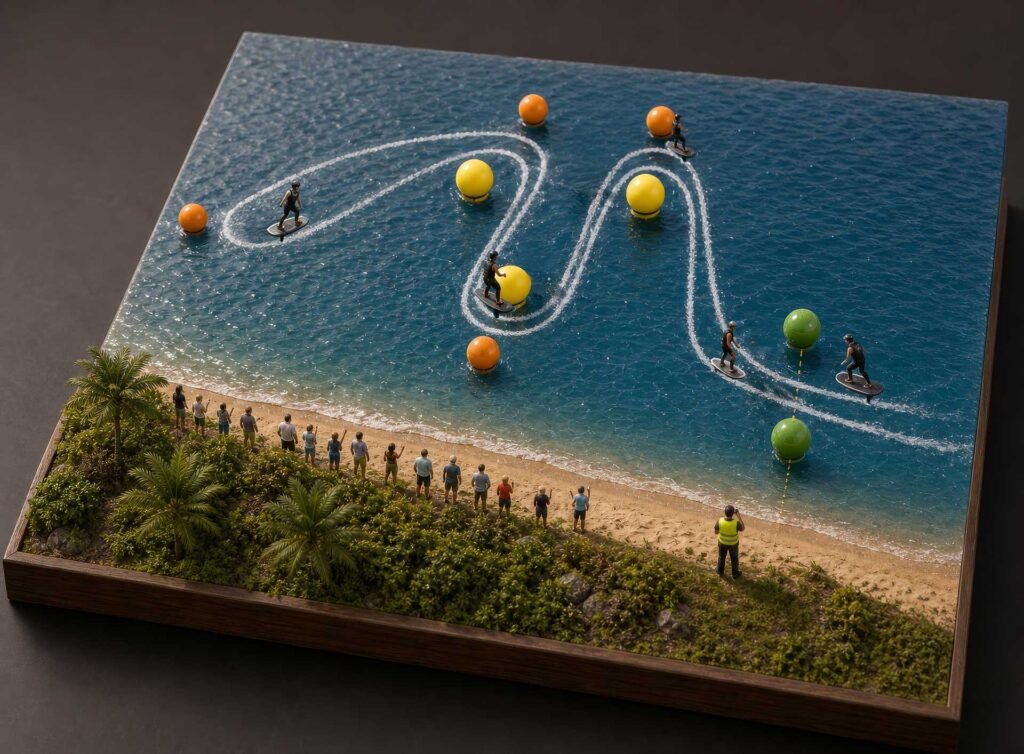
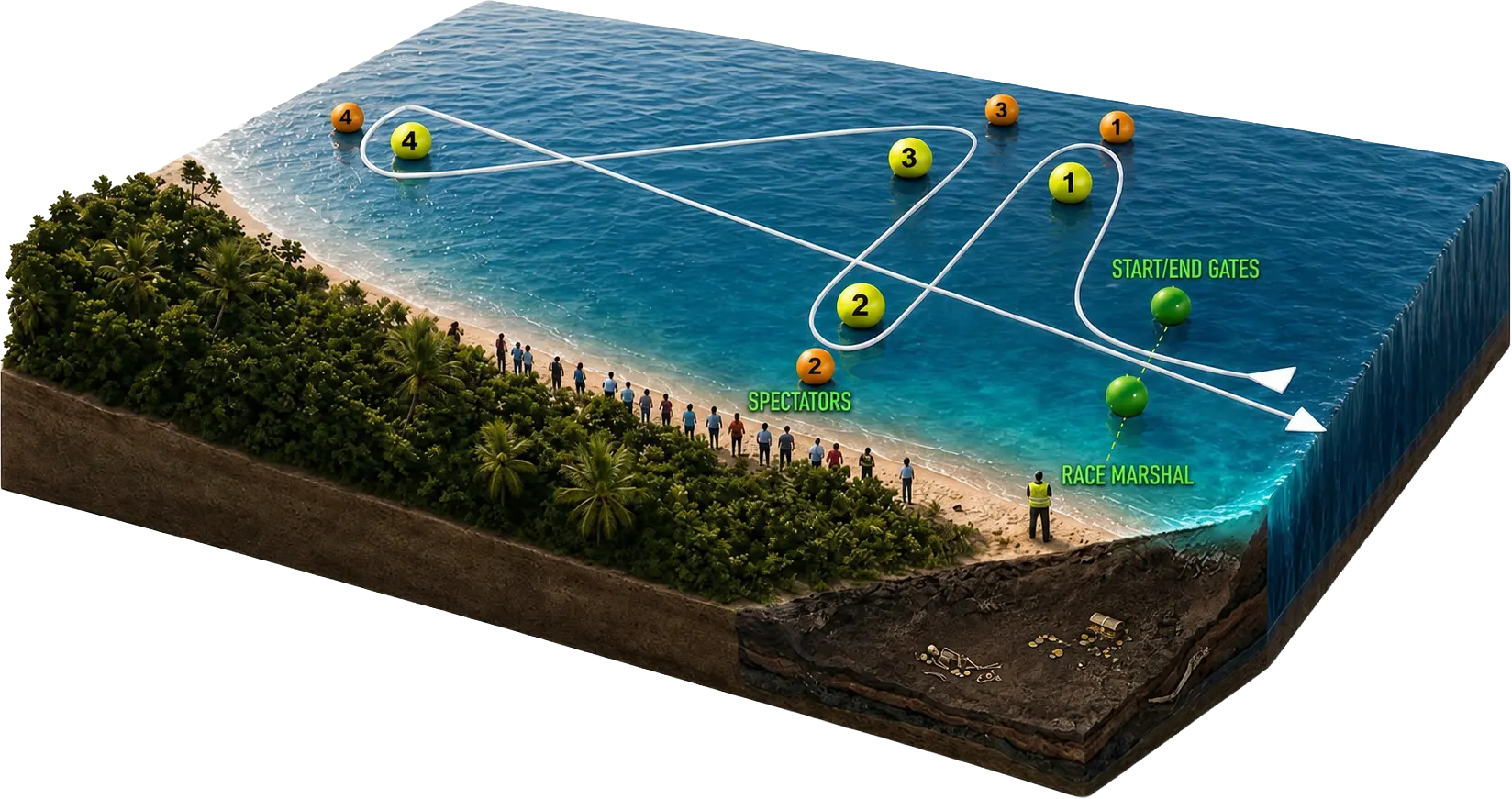
Verdant Ride eFoil racecourses are all half-mile races. That is the sweet spot: long enough for racers to settle into a flow and actually hone their skills, short enough to hit the checkered flag before fatigue sets in.
We offer two layouts. Choose the Extended course if you have a lot of space and want a mix of high speed and agility. The Compressed course fits into a much smaller footprint and tests carving and agility. Honestly, both are about equally challenging, and both are exciting to race and to watch. There is more detail on both in our How to Build a Course guide.
Both layouts below use the exact same hardware: four yellow course marks and one green start/finish gate. Nothing extra to buy.
A Quick Note on These Distances
Half a mile is 2,640 feet. The distances below are racing line distances, not buoy-to-buoy tape measurements. A rider carving around a mark travels farther than the straight line between two buoys, so these layouts already account for the arc of the turn. Get within about five percent and you are fine. Every course drifts a little anyway.
The Extended Course: Three Big Laps
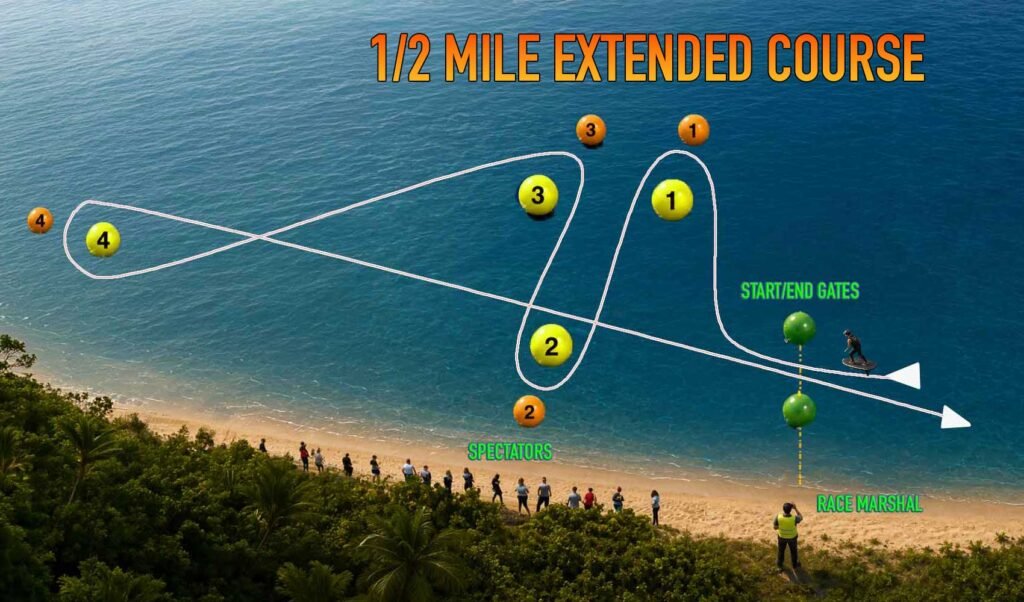
This is the speed course. Set your four yellow marks at the corners of a long, skinny rectangle measuring 375 feet on the long sides and 60 feet across the ends. Place the green start/finish gate roughly halfway down one of the long straights, 20 feet wide, with the two buoys set perpendicular to the direction of travel so riders shoot straight through it.
Riders run it as an oval, keeping all four yellow marks on the same side. The racing line works out to about 875 feet per lap, so three laps lands you at roughly 2,630 feet, a hair under half a mile.
What makes this course fun is that it is only six real turns for the entire race. Riders get two long full-throttle straights per lap where they can pin it and trim for top speed, then they have to scrub just enough at each end to hold the foil through the turn without breaching. It rewards commitment more than finesse.
You will want about 450 by 150 feet of clean open water, plus run-off room past each end.
Building the double-pole version? Each end of the rectangle becomes a pair of 8-foot gates that riders must exit through after the turn. That is the money shot for spectators, because it forces a clean, tight exit line instead of a lazy wide arc.
The Compressed Course: Six Tight Laps
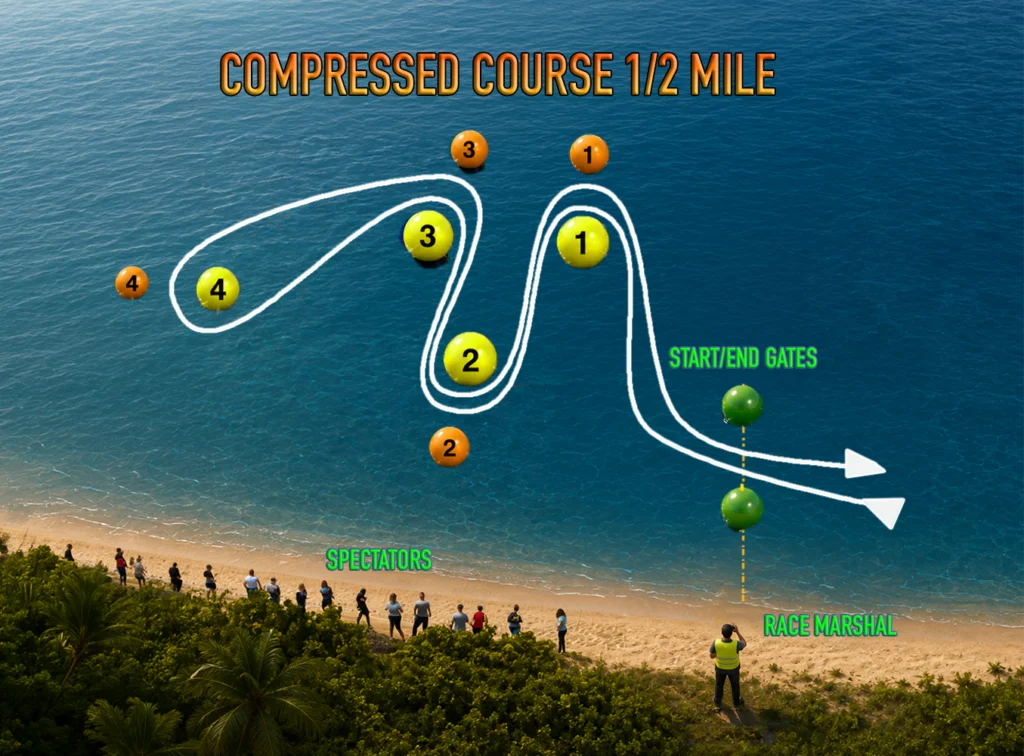
This is the carving course, and it fits almost anywhere. Set your four yellow marks in a single straight line, 45 feet apart, so the whole line spans 135 feet. Place the green start/finish gate 30 feet before the first mark, aimed straight down the line.
Riders cross the gate, slalom the four marks alternating sides, round the last mark, and slalom back the other way through the gate. That is about 435 feet per lap, so six laps gets you to roughly 2,600 feet.
The whole thing lives in a footprint of about 220 by 100 feet, which means a small lake, a protected cove, or a quiet corner of a marina will hold it comfortably.
It is also dramatically more work to ride. Six laps is somewhere north of forty direction changes, compared to six turns on the Extended course. Riders are never at full throttle and never fully unloaded, and that is exactly where you find out who has genuinely learned to carve on both sides and who has a strong side and a survival side.
For the double-pole version, the four marks become four 8-foot gates and the slalom turns into a proper alternating gate run. Start at 8 feet for your first event. If you want to make the finals brutal, tighten the middle two gates to 5 or 6 feet and leave the outer two at 8.
Setting It Accurately Without a Survey Crew
Once you set a few courses you’ll be able to eyeball it pretty well but if you want to nail it, have a friend throw a drone up in the air while you paddle out there and start dropping anchor lines. I highly recommend setting the course with a kayak or a a paddle board. You don’t want to be swimming out there with weights, anchors and getting tangled up in line or managing your efoil and all the lines.
- Set anchor lines with about 2′ of extra slack so buoys can ride the chop without wandering into the racing line. Or take our advice and build some of those self-leveling anchor lines.
- Leave clear run-off room past every turn mark. Riders will overshoot on lap one.
One Last Tip Before Your First eFoil Race
Use time effectively and make the races exciting!
Let riders hit the starting gate at full speed then start the timer when they pass through. These are much more exciting than starting from a dead stop and you can process racers faster if the racer that is ready to go goes versus calling the name of someone and waiting for them to get on their board and ride. I usually just complete all 3 of mine right away then I spend the rest of my night either coaching riders or helping out with the marshaling, or just flying the drone to get cool shots of racers.
A good course should take a competent rider out 60 seconds to complete. Your most competent rider should pre-run the course to check if it is close to that 60s mark. Faster than that and your turns are too easy, spread them out a bit so they have to carve into them harder. Longer than that and it will take too long to process everyone effectively through their 3 runs. These courses were invented to get a decent sized group through the course after work before the sun goes down.
Before the first heat, send the whole field around the course once, untimed. New racers almost always miss a mark on their first pass, and one warm-up lap will save you from re-running half your field. It also lets your judge confirm the camera angle on the gate before it counts.
Set your venue, pick your date, build your course, and let Race Marshal handle the rest. Then go find out how much faster and better at carving you get when you are forced to do it against the clock.
A large digital timer clock will set you back a couple of hundred buck but they do make the game a lot more fun when you slam through the finish line to see those red glowing numbers on the board.
One rider in the course at a time!
I’ve been in courses where we all race at the same time. They are super exciting. It feels like motocross but they are way too dangerous. Someone falls and the chances of getting hit by another rider are just too dangerous for me to consider endorsing this type of behavior. Remember, an efoil is an essentially a vast moving samurai sword being trailed by a spinning set of blender blades. Don’t trade excitement for safety. It isn’t worth it.



Leave a Reply
You must be logged in to post a comment.