
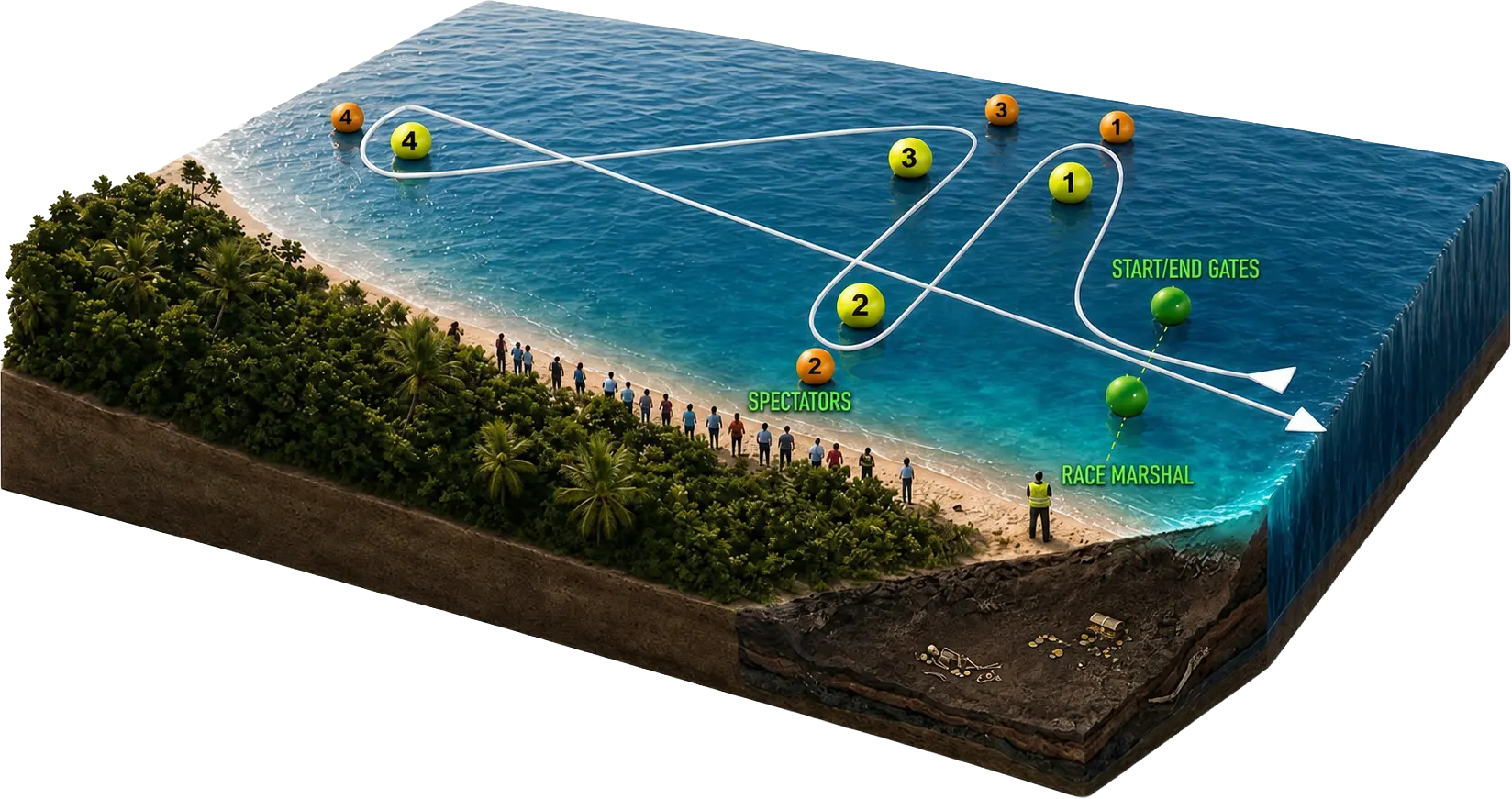
Every Verdant Ride race is half a mile, and every course is built from the same six marks. That is deliberate. A time set in a sheltered cove has to mean the same thing as a time set on open water, or the league table is just a list of unrelated afternoons. The distances below are fixed. Which of the two layouts you build is up to the water you have.
Core rules for every course
- Distance: half a mile of racing line, 2,640 ft or 805 m.
- Hardware: four yellow turn marks and one green start and finish gate. Both layouts use exactly the same kit, so there is nothing extra to buy for one over the other.
- Colour: yellow for turns, green for the gate. Riders need to read the course at speed and from a low angle.
- Running start: riders arrive at the gate already up and moving, and the clock starts as they cross. It is far better to watch than a dead-stop start, and it moves a field through three runs each much faster.
- Three runs each, best single time counts.
- One rider on the course at a time. No exceptions.
- Target time: roughly 60 seconds for a strong rider over the full course. Tune the spacing until you are close to it.
A word on the distances
Half a mile is 2,640 ft. Every figure on this page is racing line, not a tape measure laid between buoys. A rider carving a mark covers more ground than the straight line between two points, and the layouts already allow for the arc of the turn. Land within about five percent and you are fine. Courses drift a little anyway.
The two league layouts
There are two approved shapes. Extended is the speed course and wants a good stretch of clean water. Compressed folds into a fraction of that footprint and quietly exposes anyone with a weak side. They are about equally demanding, just demanding in different ways, and both are good to watch from the beach.
Extended: three big laps
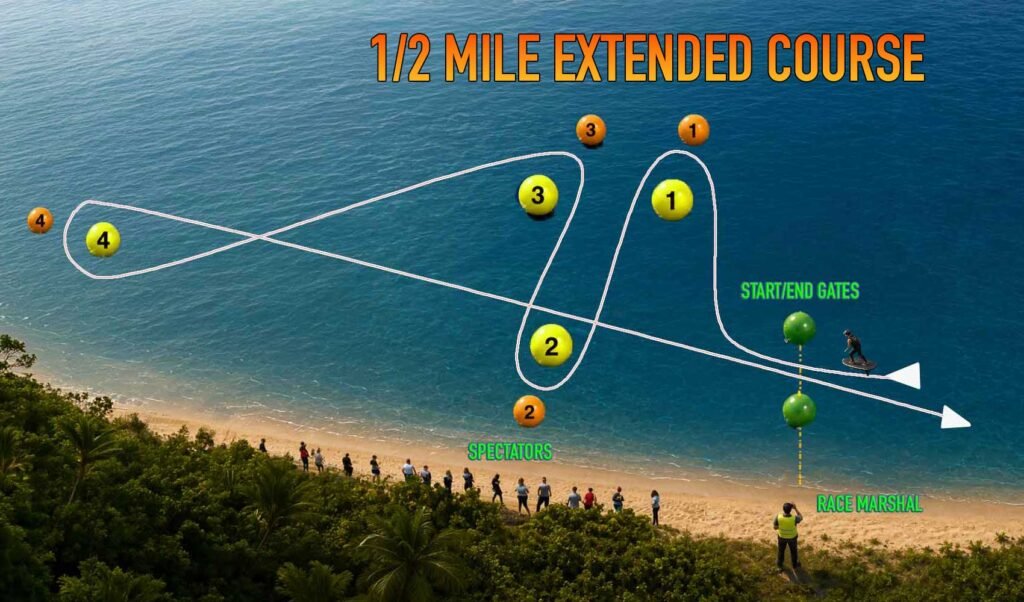
Set the four yellow marks at the corners of a long, narrow rectangle, 375 ft along the long sides and 60 ft across the ends. Put the green gate about halfway along one of the long straights, 20 ft wide, with the two buoys square to the direction of travel so riders shoot straight through rather than angling across it.
Riders run it as an oval, keeping all four marks on the same hand. That comes out at roughly 875 ft a lap, so three laps lands at about 2,630 ft, a whisker under the half mile.
What makes it fun is that the entire race is only six real turns. Two long straights a lap where riders can pin the throttle and trim for top speed, then just enough scrub at each end to hold the foil through the turn without breaching. It rewards commitment far more than finesse.
- Marks: rectangle, 375 ft by 60 ft.
- Gate: 20 ft wide, midway along one long straight, square to the direction of travel.
- Laps: three, about 875 ft each.
- Water needed: roughly 450 by 150 ft of clean surface, plus run-off room past both ends.
Compressed: six tight laps
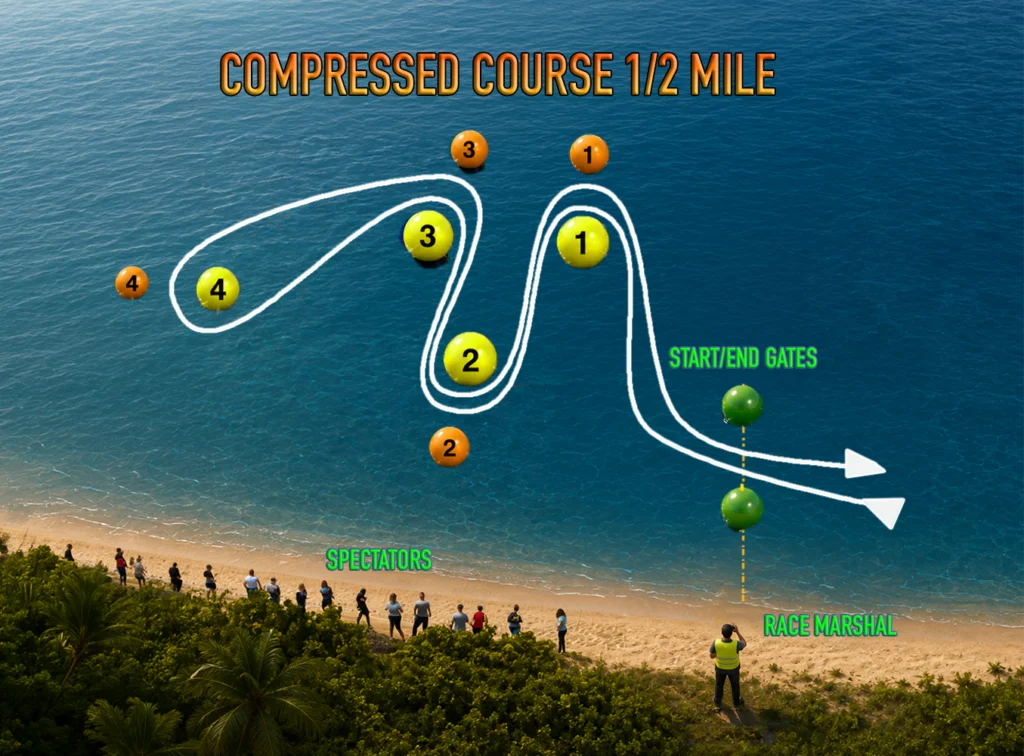
Set the four yellow marks in a single straight line 45 ft apart, so the whole line spans 135 ft. Put the green gate 30 ft ahead of the first mark, aimed straight down the line.
Riders cross the gate, slalom the four marks taking alternate sides, round the last one and slalom back the other way and out through the gate. That is about 435 ft a lap, so six laps brings you to roughly 2,600 ft.
The whole course lives inside about 220 by 100 ft, which means a small lake, a sheltered cove or a quiet corner of a marina will hold it comfortably. It is also dramatically more work to ride. Six laps is somewhere north of forty direction changes against six turns on Extended. Riders are never at full throttle and never fully unloaded, and that is precisely where you find out who has genuinely learned to carve both ways and who has a strong side and a survival side.
- Marks: four in a straight line, 45 ft apart, spanning 135 ft.
- Gate: 30 ft ahead of the first mark, aimed down the line.
- Laps: six, about 435 ft each.
- Water needed: roughly 220 by 100 ft.
Single pole or double pole
Both layouts above are described single-pole, one buoy per mark. Adding a second buoy at each mark turns it into a gate riders have to pass through. That tells newer riders which side to round, and it forces a clean, tight exit line instead of a lazy wide arc, which is the shot spectators actually want. The cost is twice the buoys, twice the anchors, and noticeably longer to set and pull.
- Standard gate: 8 ft. Tight is 4 ft, generous is 10 ft.
- Extended: each end of the rectangle becomes a pair of 8 ft gates that riders must exit through after the turn.
- Compressed: the four marks become four 8 ft gates and the slalom turns into a proper alternating gate run.
- Tuning the finals: start everyone at 8 ft. If you want a brutal final round, tighten the middle two gates to 5 or 6 ft and leave the outer two at 8.
What you need to build one
Six marks, one anchor per mark, and line to join them. That is the entire shopping list. Exact brands, models and current prices are in the guide to hosting an eFoil race, so they only have to be kept up to date in one place.
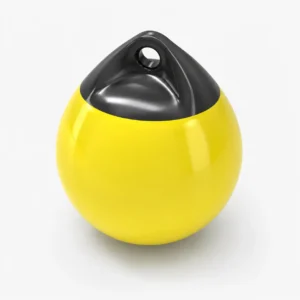
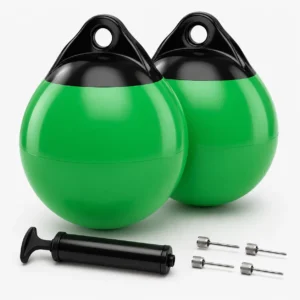
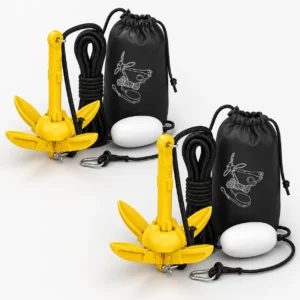
- Turn marks: four inflatable fender balls as a minimum, eight for double-pole.
- Gate: two buoys in green so the gate is never confused with a turn mark.
- Anchors: one per buoy, so six minimum and ten for a double-pole build. Folding grapnel kits arrive with line, a float and a bag. A cinderblock costs about two dollars and is genuinely miserable to haul.
- Line: enough to reach the bottom at every mark, with a little to spare.
Upgrades that cut your setup time
None of this is required. All of it removes a headache.
Make the buoys self-adjusting
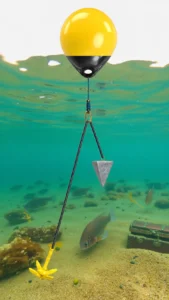
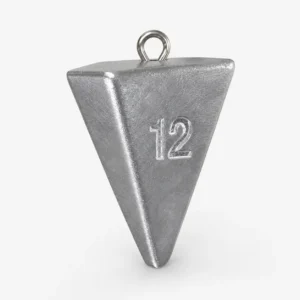
Rather than tying a buoy straight to its anchor, run the line up from the anchor, through the hole in the buoy, and finish the tail with a 12 oz pyramid sinker. The buoy now rides up and down with the water level and sits directly over its anchor point. It also helps the gate hold station in wind, because the buoys can wander in the chop and then settle back exactly where they started.
Line that survives a whole season
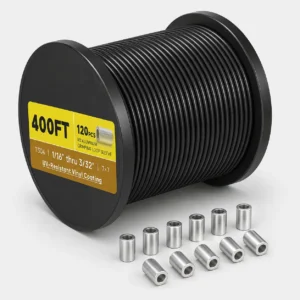
If you plan to leave the course in the water all season, rope is the wrong choice. It turns foul within weeks and eventually degrades. Vinyl-coated stainless cable in 3/32 in. lasts, and one 400 ft spool covers ten buoys in water up to about 25 ft deep. It is also heavier than water, so a line that ever comes adrift sinks rather than drifting off to find somebody’s prop.
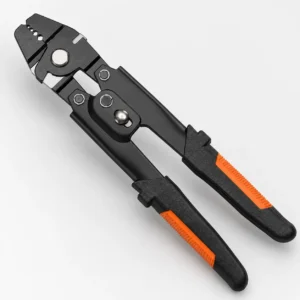
You will need a cutter and crimper to work with it, plus a set of cheap spring-loaded carabiners or snap hooks, two per line, so teardown takes minutes. A single two-in-one tool handles both jobs and puts a whole course together in an afternoon.
Setting the course accurately
- Set the marks from a kayak or a paddleboard. Do not swim it, and do not try it from your eFoil. Weights, anchors and loose line are a bad combination to be managing while balancing on anything.
- Have someone put a drone up while you drop the lines. Eyeballing gets good after a few builds, but a drone gets it right the first time.
- Leave about 2 ft of slack in each anchor line so buoys ride the chop without wandering into the racing line, or build the self-adjusting version above and stop thinking about it.
- Leave clear run-off room past every turn mark. Somebody will overshoot on the first lap.
- Re-check the positions after the first few runs. eFoils pull light anchors.
- Make the far end of the course the most visible mark you own, so nobody loses the shape at speed.
Timing it and tuning it
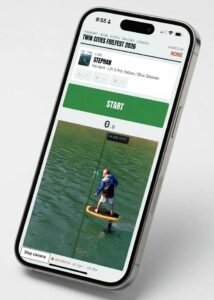
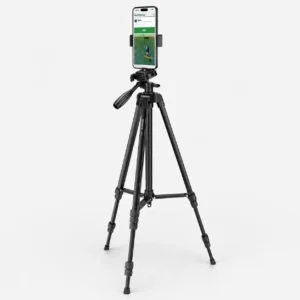
Time the course with Race Marshal. Every rider who has RSVP’d is already loaded into the roster, so you tap the next racer and go. Keep the phone aimed at the gate, hit start as the nose breaks the plane on the way in and end as it breaks on the way out, then use the frame-by-frame review to land the exact moment. Times come out to a sixtieth of a second, which is finer than anyone’s eyes and thumbs, so the closest finishes of the day end up being the ones nobody argues about.
- Have your quickest rider run the full course before anyone is timed, and check the clock.
- Under 60 seconds: the turns are too easy. Spread the marks out so riders have to carve harder into them.
- Over 60 seconds: you will not get a full field through three runs each before the light goes.
- Send the whole field around once, untimed, before the first heat. New racers almost always miss a mark on their first pass, and one warm-up lap saves you re-running half the entries. It also lets the Marshal confirm the camera angle on the gate while it still does not count.
- A large digital timer on the beach is a couple of hundred dollars and entirely optional, but watching your own number come up in glowing red as you cross the line does add something.
Build checklist
- Pick Extended or Compressed based on the water you actually have.
- Decide single-pole or double-pole, then count your buoys and anchors accordingly.
- Set the four yellow marks to the spacing for your layout.
- Set the green gate: 20 ft wide midway along a long straight for Extended, or 30 ft ahead of the first mark for Compressed.
- Have a course tester ride the full course and record the best time.
- Adjust the mark spacing until a strong rider is close to 60 seconds.
- Register the course and event so it lands on the league calendar and riders can find it.
- Tell every racer the layout, the lap count and the running-start rule before the first heat.
Safety and practical notes
- One rider on the course at a time. Mass starts look like motocross and are genuinely dangerous. A rider who falls in front of another is not a risk worth taking for a better spectacle. An eFoil is a fast-moving blade trailing a spinning prop. Do not trade safety for excitement.
- Soft marks only: inflatables, fenders, jugs, closed-cell foam. Nothing rigid, metal or sharp.
- Leave open water outside the course for everyone else using the lake.
- Mark the gate clearly so non-racers understand it is a timing line.
- If wind or current is strong, bias the course so the longer legs run down-wind or down-current where you can.
