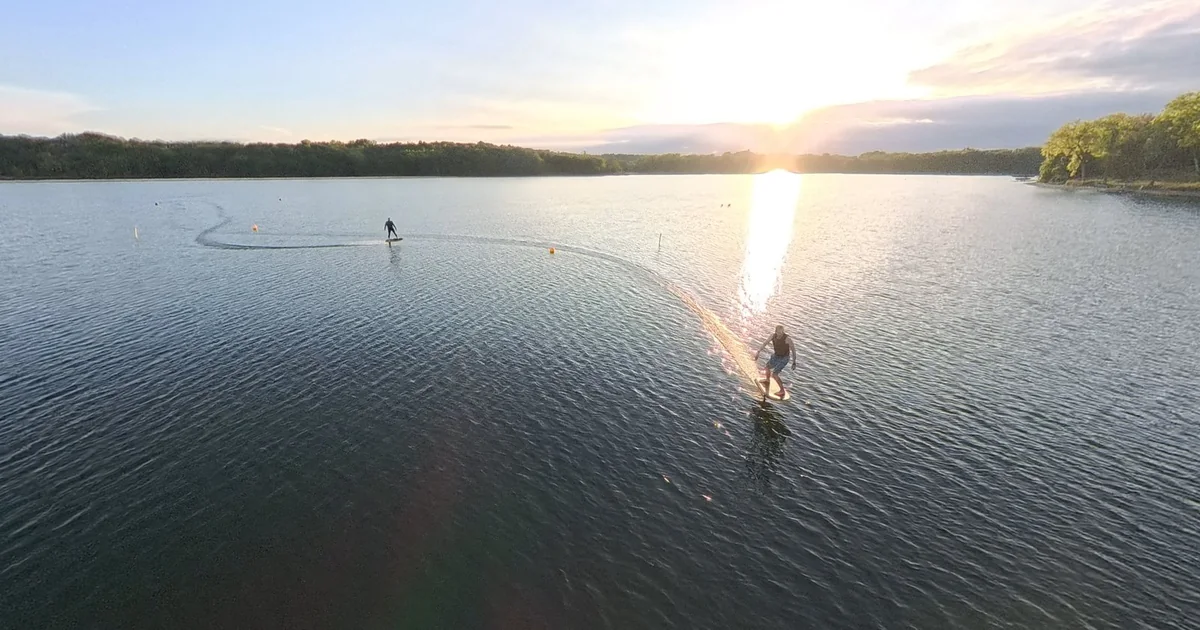
An eFoil is an electric surfboard that flies. A battery-powered propeller pushes the board forward, and a hydrofoil wing under the water lifts it clear of the surface, so the rider glides above the surface of the lake or sea in near silence. No wind, no waves and no boat are needed: you steer with your feet and control speed with a wireless hand remote.
This page is Verdant Ride’s reference on eFoiling, written from the water rather than from a spec sheet. It draws on the Verdant Ride video library of more than 160 episodes, on 517 rides logged by the community, and on live manufacturer pricing read on 21 September 2026. Where a manufacturer’s claim and real riding disagree, both are shown.
| Question | Short answer |
|---|---|
| What is it? | A surfboard with an electric motor and a hydrofoil wing, controlled by a handheld remote. |
| How fast? | The community’s rides average about 13 mph. The fastest sustained minute logged in the last 30 days was 32.6 mph. |
| How long per charge? | Manufacturers claim 45 to 120 minutes depending on the battery. Logged community sessions average about 51 minutes. |
| How much? | Complete setups start around $6,500 (SiFly lists sets from €4,999) and the mainstream flagships sit between about $11,000 and $15,000 (21 September 2026). |
| How hard to learn? | Many first-timers are standing and flying within a single session, some within about ten minutes. |
| License? | In the US the Coast Guard treats them as motorized vessels; registration rules come from your state. |
What is an eFoil?
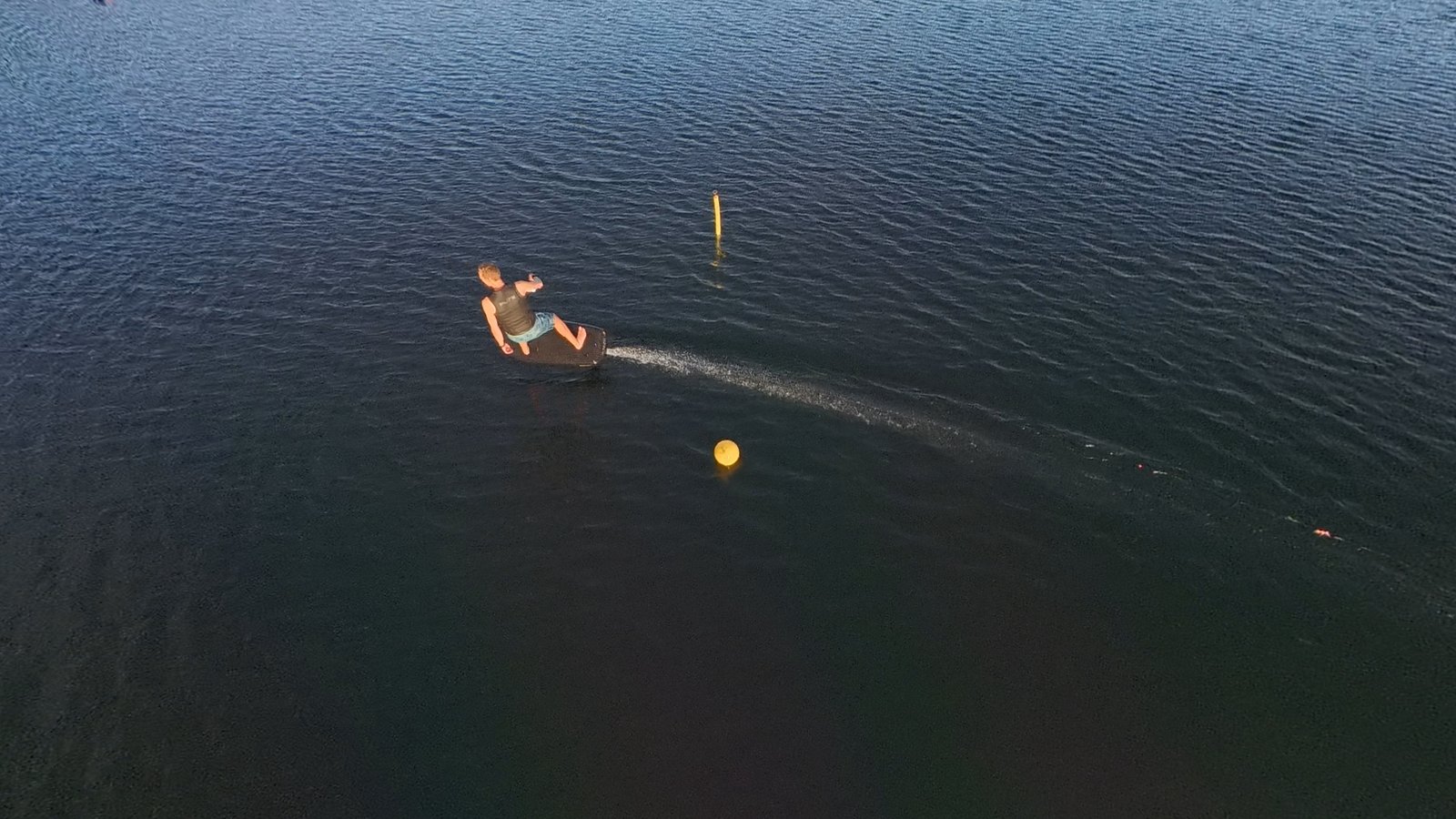
An eFoil, short for electric hydrofoil, is a board you stand on like a surfboard, with a vertical strut called a mast underneath it. At the bottom of the mast is a small aircraft-like wing and an electric motor driving a propeller. Speed up, and the wing generates enough lift to raise the whole board out of the water. Once it is up, the only things touching the water are the mast, the wings and the propeller, which is why the ride feels so smooth: the chop that would slam a boat hull passes underneath you.
The same principle has been used on boats for more than a century; the history of the hydrofoil covers how it got from naval experiments to a board you can carry to the beach. What made the eFoil possible was putting a compact motor and a high density lithium battery into something one person can ride. Lift Foils markets its boards as the original eFoil, and the story of that first flight is told in what the first working eFoil flight must have felt like.
The parts of an eFoil
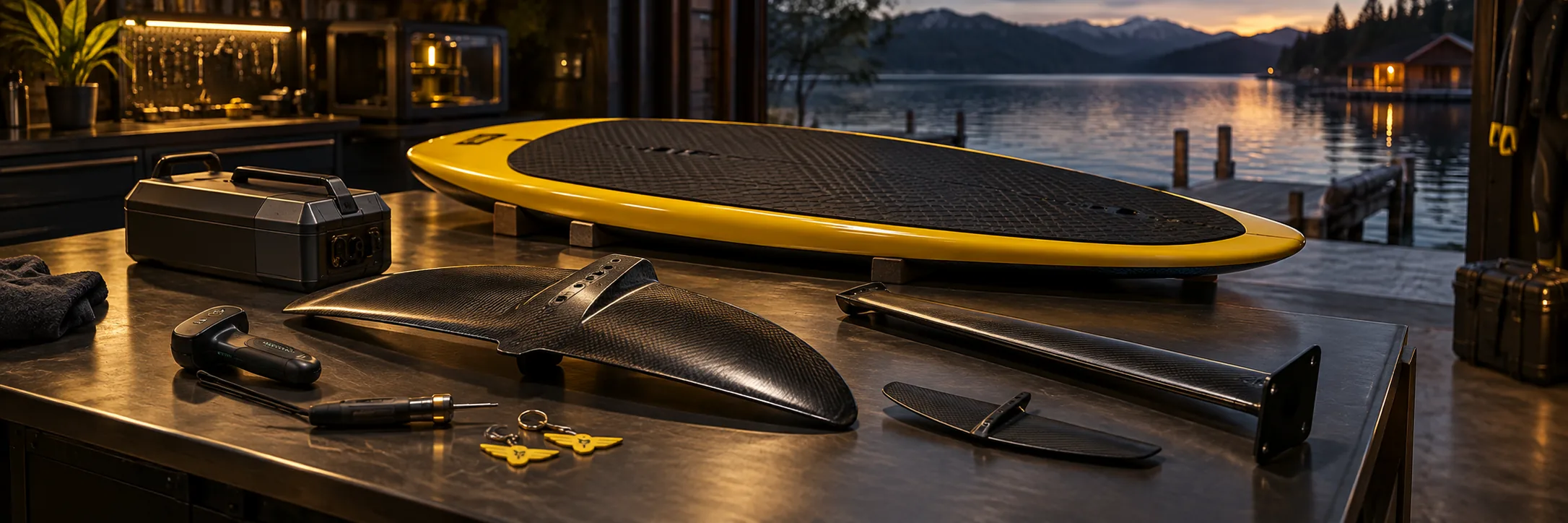
- Board. Carbon, fiberglass or foam. The battery sits in a sealed compartment in the deck. Bigger boards are more stable and easier to start on; smaller boards turn harder.
- Mast. The strut connecting board to foil, usually aluminum or carbon, and it sets how high you fly. It also carries the power cable. Aluminum versus carbon masts covers why the material changes the sound and feel.
- Motor and propeller. Mounted on the mast or the fuselage. Some are shrouded in a duct, which is quieter and safer around people; the eFoil propulsion types guide explains the trade-offs.
- Front wing. The part that makes the lift. A large wing lifts at low speed and is stable; a small wing needs more speed but carves harder and goes faster.
- Stabilizer. The small rear wing, also called the tail or stab, which keeps the foil level in pitch.
- Battery. The heaviest and most expensive single component, typically between 1 and 2.3 kWh on current models.
- Hand controller. A waterproof wireless remote with a trigger for throttle and usually a screen showing speed and battery. Let go and the motor stops.
How does an eFoil work?
Squeeze the trigger and the propeller pushes the board forward like a slow paddleboard. As speed builds, water flowing over the front wing produces lift, the same way air lifts an aircraft wing. At takeoff speed that lift exceeds the weight of board and rider and the board rises. From then on you are balancing on the wing, not floating on the board.
Height is controlled with your feet. Weight on the front foot pushes the nose down and lowers you; weight on the back foot raises the nose and climbs. Too much back foot and the wing breaches the surface, loses lift and drops you in. Turning is done by leaning, exactly like a surfboard or a snowboard, and because the wing is under the water the board banks into a turn rather than skidding across it. That banked turn is the carve, and it is why most people who try eFoiling keep doing it.
Riding on the foil is far more efficient than pushing a hull through the water, which is how a battery the size of a suitcase can carry an adult for an hour or more. It also explains why eFoils are so quiet: there is no hull slapping on chop and the motor is under the surface.
How long does it take to learn to eFoil?
Less time than most people fear. In three riders learning to eFoil, a first-time rider with no board sports background goes from lying on the board to foiling roughly ten minutes into her first ever session. The same episode follows riders five and twenty-one sessions in, which is where carving and control come.
The route that works best is the one shown in one rider’s first summer: book a lesson first, then buy. A large front wing lifts at lower speed, which is what makes early sessions forgiving. Most schools teach in the same order:
- Lying down. Learn the throttle and how the board steers, with no attempt to fly.
- Kneeling. Get used to speed and balance with a low centre of gravity.
- Standing, board on the water. Feet in position, cruising like a powered paddleboard.
- First flight. A little more speed and a little back foot until the board lifts. Keep it low.
- Holding height. Small foot adjustments to stay level instead of porpoising up and down.
- Turning, then carving. Gentle leaning turns first. How to carve on an eFoil covers speed, body position and the S-turn in detail.
Foot position matters for safety as much as control. Why a staggered stance is safer explains how offsetting your feet lets you choose which side you fall to, which keeps you away from the foil.
How fast does an eFoil go?
Most riding happens at a relaxed cruise. Across 5,733.9 miles and 441.5 hours of rides logged on Verdant Ride as of 21 September 2026, the average speed works out to about 13 mph. Top speed depends on the wing: small, fast wings are built for it, big beginner wings are not.
| Source | Figure | What it measures |
|---|---|---|
| Community ride logs | about 13 mph | Total miles divided by total hours across 517 logged rides |
| Community leaderboard, last 30 days | 32.6 mph | Fastest sustained 60 seconds from a GPX track |
| Waydoo Flyer EVO Pro Plus, manufacturer | 32 mph | Claimed top speed |
Watches report a session maximum, which is easily inflated by a single GPS spike. The community leaderboard uses the best sustained minute instead, and sorting garbage and filtering noise in eFoil GPS data explains why. To see speed on screen as a ride happens, watch how fast you go on an eFoil, with a real time speed overlay.
How long does an eFoil battery last?
Ride time depends on battery size, rider weight, wing size and above all speed. Cruising on a big wing uses a fraction of the energy of flat-out runs. Manufacturer figures are best-case numbers, so they are worth reading next to what riders actually log.
| Setup | Battery | Claimed ride time |
|---|---|---|
| Lift LIFT5 (carbon) | 2.2 kWh Gen5 Full Range | up to 90 min |
| Lift LIFT5 F (fiberglass) | Gen5 Full Range | up to 75 min |
| Lift LIFTX | 1.0 kWh | up to 45 min |
| Waydoo Flyer EVO Pro Plus | 2,300 Wh | 120 min |
| SiFly (current range) | not published on the page | up to 120 min |
On the community logs, the average session is about 51 minutes and about 11 miles long, and riders cover roughly 0.16 miles per percent of battery, which works out to around 16 miles on a full charge. That is not a contradiction of the claims: many sessions end with charge left, and the fastest riders drain a battery far quicker than the cruisers who set the averages.
Batteries are also where most ownership problems live. Lift battery error codes explained decodes the warnings, Lift Faceplant Syndrome traces a sudden mid-ride cut-out to a small amount of water around the antenna, and a solar cooled charging cabinet shows one way to keep batteries out of the heat.
How much does an eFoil cost?
A complete eFoil, meaning board, mast, motor, battery, wings and remote, currently costs from about $6,500 to about $15,000 from the major brands (SiFly lists sets from €4,999), with design and racing editions running close to $20,000. Prices below were read directly from each manufacturer’s own site on 21 September 2026.
| Model | Starting price | Notes |
|---|---|---|
| Waydoo Flyer EVO Pro Plus | $6,499 | EPP foam board, 2,300 Wh battery, 120 min claimed |
| Fliteboard Flite AIR | from $6,995 | Fliteboard’s own entry model |
| SiFly Rider eFoil Set | from €4,999 | Published in euros; Stellar X set €7,999 |
| Fliteboard PRO | from $10,999 | Standard configuration with Flitecell Sport battery |
| Lift LIFT5 F | $10,999 MSRP | Fiberglass board, aluminum mast |
| Lift LIFTX | $13,999 MSRP | Light carbon board, 1.0 kWh battery |
| Lift LIFT5 | $14,999 MSRP | Carbon board, 2.2 kWh battery |
| Fliteboard Marc Newson MN86 | $19,995 | Design edition, top of the market |
The sticker price is only part of it. Budget for a second battery if you ride with friends, a wing or two as you progress, a board bag, protective gear and, depending on your state, registration. Whether an extended warranty is worth it and the fine print on buying a Fliteboard both cover the costs that arrive after the purchase.
Which eFoil should you buy?
Start with how you want to ride, not with the brand. Three questions narrow it down quickly:
- Cruising or carving? Long, relaxed rides favour a bigger battery and a larger wing. Hard carving and speed favour a smaller board and wing.
- How much do you weigh? Heavier riders need more wing area and more board volume to get up easily. Matching wing and board size to weight and ride style works through the rule: size the foil to you, then take the smallest board you can manage.
- Who else will ride it? A board that has to suit a family and first-time friends wants a bigger, forgiving setup, even if you would personally choose something sharper.
For head to head comparisons from the Verdant Ride library, see the Lift Foils CEO on which eFoil to buy, LiftX versus LIFT5 Pro, Fliteboard versus Lift and the SiFly Stellar X review. Brand pages for Lift Foils and Fliteboard collect everything else in one place.
Is eFoiling safe?
eFoiling is safe when you respect two things: the foil and the water. The wing and propeller sit under the board, and most injuries come from landing on or near the foil during a fall. The core habits are simple:
- Fall away from the foil. Step or dive off to the side and away, never forward over the nose. A staggered stance makes this a choice rather than a reflex.
- Let go of the remote. Releasing the trigger stops the motor, and most remotes have a kill switch or safety mode too.
- Wear protection. A properly fitted impact vest or self-righting PFD and a helmet meaningfully reduce the chance of serious injury. Helmets and PFDs on an eFoil sets out Verdant Ride’s position.
- Keep your distance. Stay well clear of swimmers, docks and other boats, and slow down near shore.
- Know the water. Submerged hazards are the big one. An eFoil hitting a submerged tree at 26 mph shows what happens, and why the mast separating from the board was the safety design working.
- Have a way back. Boards drift faster than you swim. The Kaper Call technique shows how to bring a runaway eFoil back to you.
Do you need a license to ride an eFoil?
In the United States, eFoils are regulated as motorized vessels. In October 2022 the US Coast Guard set requirements for eFoils and jetboards that include carrying the vessel’s registration certificate when underway, personal flotation devices that meet state and federal rules, a sound producing device, navigation lights when required, and an engine cut-off switch from the manufacturer; a fire extinguisher is required unless every rider wears a Coast Guard approved PFD.
Registration itself is handled by your state, and the rules differ. California registers eFoils through the DMV, Florida through the Fish and Wildlife Conservation Commission, and New York through the DMV. Some lakes and waterways restrict or ban motorized craft altogether regardless of state law. Check your state boating agency and any local rules before your first ride; this page describes the rules and is not legal advice.
Where can you ride an eFoil?
Almost anywhere with flat or gently moving water deep enough for the mast: lakes, bays, harbours, calm rivers and sheltered coastline. You need at least mast depth plus a margin, and more is better when you are learning. Glassy mornings and evenings are the best conditions, but eFoils also ride happily through chop that would stop a paddleboard.
To see where other riders go, the map on Community Ride Data shows approximate locations from logged rides, and Find eFoil Events lists meetups and races you can join. Riding in the ocean is a step up in skill; a first day of eFoiling in ocean waves shows what changes.
How do you look after an eFoil?
Rinse everything in fresh water after every session, especially in salt water, and dry the battery compartment and connectors before closing it up. Store batteries at a partial charge somewhere cool, and check bolts, the propeller and the seals regularly. The saltwater eFoil maintenance guide walks through the routine in full, and labelling every wing and battery makes a growing quiver manageable.
eFoil racing
Once you can carve, racing is the fastest way to get better. The Verdant Ride eFoil Racing League runs time trials on a short out-and-back slalom course, with a handicap that makes times comparable across venues. See the races and results, learn how to host an eFoil race yourself, or build a cheap DIY race course. For racing at the international level, see Germany’s first eFoil World Cup.
eFoil versus other ways to ride
| eFoil | Surf foil or wing foil | Wakesurfing | |
|---|---|---|---|
| Needs | A charged battery | Waves or wind | A boat and a driver |
| Where | Any flat or moving water deep enough for the mast | Where the waves or wind are | Behind the boat |
| Learning curve | Often flying on day one | Usually longer | Moderate |
| Noise | Near silent on foil | Silent | Boat engine |
For a side by side from the water, watch eFoil versus wakesurf and surf carving versus eFoil carving. Flying above the water is a longer read on what the sensation is actually like.
eFoil FAQ
What does eFoil stand for?
eFoil is short for electric hydrofoil: an electrically powered board that uses an underwater wing to lift itself above the surface.
Can a beginner ride an eFoil?
Yes. A large front wing lifts at low speed and is very stable, and many first-time riders are standing and flying within their first session. Taking a lesson first is the fastest and safest start.
How heavy is an eFoil?
Fliteboard lists its standard PRO configuration at 24 kg complete. Weight varies with board material and battery size, and the board, battery and foil usually come apart so you never carry the whole thing at once.
Is an eFoil loud?
No. Once the board is up on the foil the hull is out of the water and the motor is under the surface, so it is far quieter than a jet ski or a boat. A shrouded propeller is usually quieter still.
Can you eFoil in the ocean?
Yes, as long as you rinse everything in fresh water afterwards. Waves add a new skill, since the foil can ride swell, but flat, sheltered water is the best place to learn.
How deep does the water need to be?
At least the length of the mast plus a safe margin, and more while you are learning. Masts are commonly around 70 to 90 centimetres: Waydoo offers 27 and 35 inch masts, and Fliteboard’s standard PRO uses an 80 cm mast.
Do eFoils need to be registered?
In many US states, yes, because eFoils are treated as motorized vessels. California, Florida and New York all require registration. Check your own state’s boating agency.
Keep going
- Watch every Verdant Ride episode: tutorials, reviews, racing and rides, searchable by topic.
- Log your own rides and see how your speed and range compare with the community.
- Find an eFoil event near you, or host one.
- Accessories and mods and the gear section for everything that bolts on.
- The complete Verdant Ride resource hub, for everything else on the site.
Sources
Manufacturer prices and specifications were read on 21 September 2026 from each brand’s own website. They change often, so check the manufacturer before buying.
- Lift Foils, eFoils: LIFT5, LIFT5 F and LIFTX prices, batteries and claimed ride times
- Fliteboard PRO: starting price and standard configuration weight
- Fliteboard, eFoil pricing: Flite AIR and Marc Newson MN86 prices
- Waydoo Flyer EVO: Pro Plus price, battery, ride time and top speed
- SiFly: eFoil set prices in euros and claimed ride time
- Hawaii Division of Boating and Ocean Recreation: summary of the US Coast Guard eFoil and jetboard requirements of 5 October 2022
- Fliteboard, do eFoils need to be registered: California, Florida and New York registration
- Verdant Ride Community Ride Data: ride totals, averages, efficiency and the sustained speed leaderboard, read 21 September 2026
