
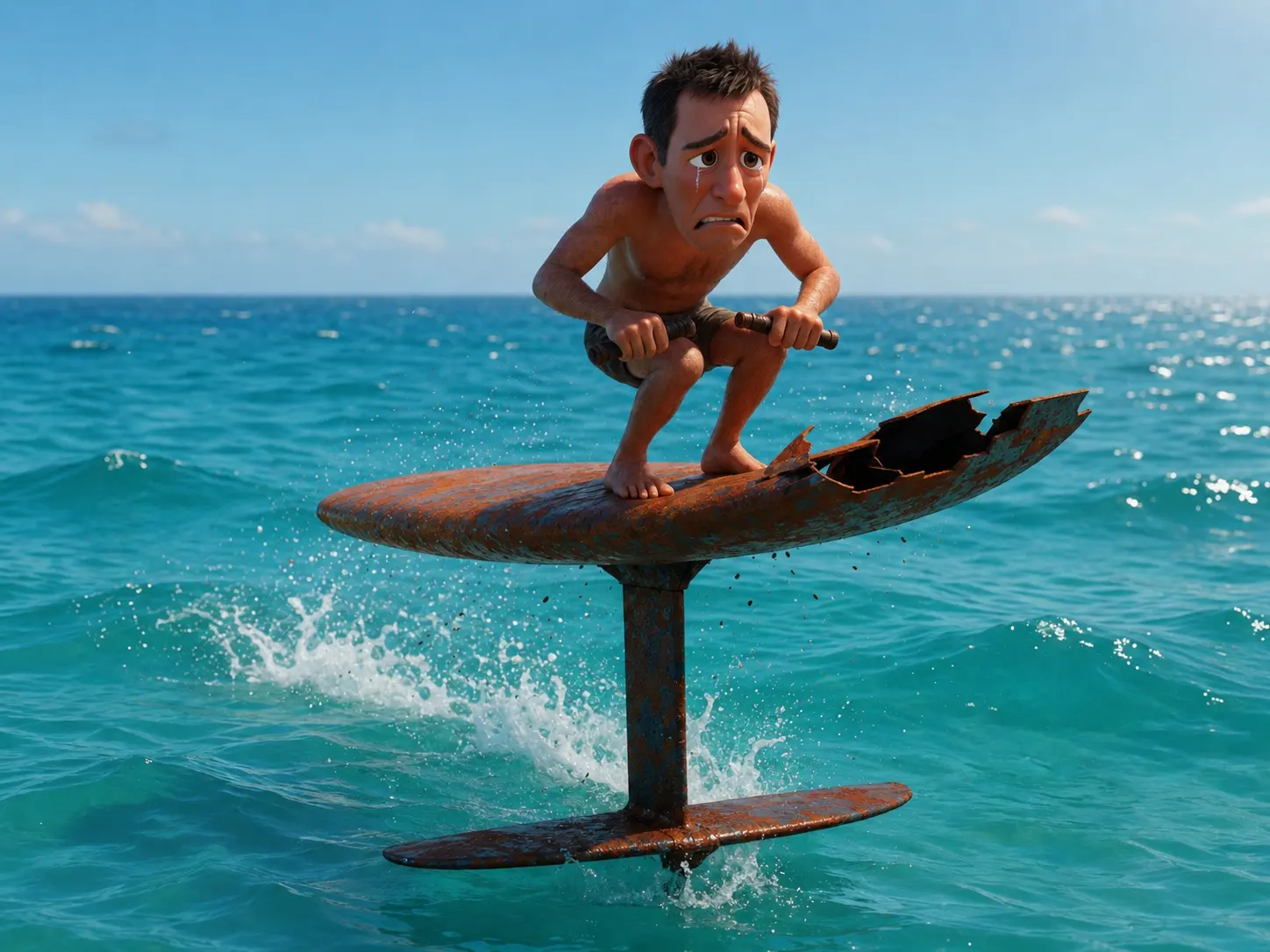

By Captain Riptide — Antigua-born eFoil addict, fine-print hunter, and barnacle-scraper of suspicious promises.
Ahoy, mateys. Let me start with a confession that will save you thousands of dollars: salt does not negotiate. Not with you, not with your warranty, not with the lovely lacquer finish on the new mast you just paid for. Salt is patient, salt is rude, and salt is going to eat your eFoil if you let it sit on the deck while you go pour a rum.
I have been running boats out of Antigua for more years than I care to admit. I’ve seen what a single ride in the Caribbean — followed by a hot afternoon and a “I’ll deal with it tomorrow” — does to high-end marine electronics. Now imagine that same salt slowly chewing on a $1,500 carbon mast bolt, or a $4,000 propulsion unit, or the very fine threads of a battery terminal that absolutely was not designed for casual neglect.
So here is the post I wish someone had handed me before my first season of saltwater foiling. It’s not glamorous. It involves a freshwater jug and a soft brush and a tube of dielectric grease. But if you ride in the ocean — really ride, repeatedly, day after day — this routine is the difference between a board that lasts five years and a board that lasts five months.
A Tale of Two Riders: Stephan vs. The Caribbean
Before we get into the routine, let me show you why this matters with two riders you already know.

Take Stephan. He rides his Lift on a glassy freshwater lake — flat morning sessions, clean water, mild conditions. His maintenance routine? Wipe down, dry off, throw a little dielectric on the connectors every few weeks. That’s it. That’s plenty. He gets away with it because freshwater is, comparatively speaking, the polite cousin in the family of water types. It doesn’t carry the dissolved salts that turn into a conductive, corrosive paste the moment your gear sits in the sun. His board still looks new. His connectors still gleam. His warranty is still happy.
Now imagine Stephan packs his beautiful LiftX in the travel case, books a flight to Puerto Rico, and applies the exact same routine. One ride. He pulls the board out of the water, wipes it down, puts it on the rack, and goes to dinner. He’ll grease the connectors next weekend, like he always does back home.
He will not make it to next weekend.
By the next morning — a single day — Stephan is going to open his control box and see the faint, chalky bloom of corrosion starting at every dissimilar-metal junction. The mast joint will feel sticky. The propulsion unit’s screw heads will have a dull haze. By day three, that haze is a crust. By the end of the trip, he’s writing emails to Lift support and pretending he doesn’t know what happened.
This is not an exaggeration. This is the reality of taking a freshwater habit into a saltwater environment. The water is heavier. The air is heavier. The sun is more honest. Everything that was forgiving on the lake is unforgiving in the islands. A freshwater rider transplanted to the Caribbean has to upgrade their entire post-session routine — not in a few weeks, but in a few hours.
If you take only one thing from this post, take this: in saltwater, you rinse and grease after every single ride. Not every few rides. Not when you remember. Every. Single. Ride.
Why Saltwater Is a Different Animal
Before we get to the routine, you need to actually understand what’s happening, because once you understand it, the routine writes itself.
Seawater carries roughly 35 grams of dissolved salt per liter. Most of that is sodium chloride, but the supporting cast includes magnesium, calcium, sulfates, and a small army of other ions. When that water dries on metal, it doesn’t disappear — it leaves a thin, conductive crust behind. That crust is hygroscopic, meaning it pulls moisture out of the humid Caribbean air, which means even after your board “looks dry,” there is still a microscopic electrochemical cell sitting on every exposed joint. That cell is doing what we call galvanic corrosion — eating one metal to plate another — every minute it exists.
Now add three accelerants the lake riders never deal with: tropical UV, persistent humidity, and the simple fact that ocean spray gets everywhere. It doesn’t just hit the parts you see. It coats the inside of your nose pocket, the underside of every fastener head, the threads inside the mast, and the gasket seam of the battery housing. Freshwater riders never have to fight this. Saltwater riders fight it after every ride or they lose the war.
The 6-Minute Post-Ride Rinse Routine
This is the routine you do every single time you take the board out of the ocean. Yes, even if you only rode for ten minutes. Yes, even if you are tired. Yes, even if dinner is waiting. Six minutes. You can manage six minutes.
- Get the board out of the sun. Salt drying in direct sunlight is the worst-case scenario. If you have a shaded rack, beach umbrella, or even a wet towel to lay over the board, use it. You have a small window before the salt starts crystallizing.
- Pre-rinse with a freshwater jug or hose at low pressure. Start at the top, work down. Do not blast the seals — you are not trying to power-wash, you are trying to dissolve and carry away the salt. A gentle, full-coverage flush for sixty seconds beats a high-pressure ten-second blast every time.
- Pay attention to the mast joint, the box seam, and the propulsion unit. These are the places salt loves to hide. Spend extra seconds here. If you have a small bucket of clean fresh water, dunk the propulsion unit for thirty seconds — it lets fresh water work its way into the bearings.
- Rinse the connectors. Both ends — board side and battery side. Then pat them dry with a clean microfiber. Not paper towels (they shed). Not a beach towel (it’s salty).
- Towel-dry everything you can reach. The board, the mast, the wings, the propulsion housing. The goal is to remove standing water before it has a chance to evaporate and leave salt behind.
- Apply dielectric grease to every electrical connector. A thin smear is enough. Connector pins, battery terminals, charge port if it’s exposed. This is the step Stephan does every few weeks at home. In saltwater, this is a daily ritual.
Six minutes. That’s the whole routine. You can do it before you take off your wetsuit. You can do it while your riding buddy is still telling lies about how big the swell was. There is no excuse.
Weekly Deep-Care (Fifteen Minutes, One Beer)
The post-ride routine keeps salt off. The weekly routine catches what the post-ride routine missed and stops slow-build problems before they become expensive ones.
- Split the mast joint. Pull the bolts, separate the mast from the board (or the mast from the fuselage, depending on your setup), inspect every mating surface for discoloration or pitting. Wipe with a microfiber. Re-grease the threads with marine-grade anti-seize. Torque to spec — not “tight enough,” to spec.
- Inspect the anodes. If your board has sacrificial anodes (and it should, if you ride in saltwater — check with your manufacturer), look at them. They’re supposed to be ugly. They are doing their job by being eaten. If one is more than half gone, replace it. Anodes are cheap. The thing they protect is not.
- Spin-test the propulsion unit. With the battery disconnected, give the prop a manual spin. It should feel smooth and free. Grinding, hesitation, or a rough patch is a sign that sand or salt has made it into the bearings. Catch it now.
- Check every gasket. O-rings, battery seals, control-box gaskets. Look for flat spots, cracks, or dryness. Silicone-grease them lightly. A $4 gasket replaced on schedule is cheaper than a $4,000 control box replaced because water got in.
- Visual on every fastener. Every screw, every bolt. If you see a halo of corrosion around the head, address it now. Pull the fastener, clean the threads, re-grease, re-torque.
The Five Things That Actually Kill eFoils in Saltwater
After enough years on the water, you start to see the same failures over and over again. Here are the five I’ve seen kill more saltwater boards than anything else.
- Galvanic corrosion at dissimilar-metal joints. Stainless touching aluminum, brass touching steel, two different alloys threaded together with no isolation paste. Salt finishes the job. Always use anti-seize on dissimilar metals.
- Neglected control-box seals. The control box is the brain. Water gets in once and the brain is gone. Inspect those gaskets weekly. Replace them on the manufacturer’s schedule. If you ride in saltwater every day, replace them more often.
- Sand in the propulsion bearings. Beach launches are romantic. Beach launches are also a death sentence for prop bearings if you don’t rinse out the unit afterward. The Caribbean has gorgeous beaches. The Caribbean also has sand. Plan accordingly.
- Salt-baked battery contacts. Battery terminals see the highest current and they are usually the spots people most forget to clean. A corroded terminal increases resistance, which generates heat, which kills the battery faster. Clean them. Grease them. Every ride.
- Sun-and-salt strap rot. Not catastrophic, but annoying. Your foot straps, leash, and any neoprene get eaten by UV plus salt. Rinse them, dry them in shade, and replace them before they fail mid-session.
Brand-by-Brand Quick Notes for Saltwater Riders
Every brand handles saltwater a little differently. Here’s my read after years of watching boards die in the islands.
Lift Foils. Solid hardware, sealed propulsion, good gasket design out of the box. Where Lift owners get into trouble is the mast joint — the carbon-to-aluminum connection needs religious application of anti-seize, and a lot of riders skip it. Lift’s warranty (and any SureBright add-on you may have read about) explicitly excludes water damage, so the routine above is mandatory if you want long-term service.
Fliteboard. Beautiful Australian engineering, generally well-suited to saltwater since that’s the home market. The Achilles’ heel I see most often is the battery seal and the e-Box gaskets — meticulous about them or pay the price. Their support is reasonable but they will absolutely point at the gasket if water gets in.
SiFly. Lightweight, modular, newer to the market — the modularity is great for saltwater because it means easier inspection. But the trade-off is more connector points, and connector points are where salt does its best work. More joints, more grease.
Waydoo. The budget-friendly option. The hardware can absolutely survive saltwater if you treat it right, but the tolerances are looser than the premium brands, which means salt finds more ways in. If you ride a Waydoo in the ocean, your routine has to be the strictest of all four.
My Saltwater Kit (What’s Actually in the Bag)
- Two 5-gallon collapsible jugs of fresh water (one for rinse, one for the propulsion soak)
- Soft-bristle brush — toothbrush size for joints, larger for surfaces
- A pack of clean microfiber towels (rotate, never reuse a salty one)
- Dielectric grease — the silicone-based, marine-rated kind
- Marine anti-seize for the mast threads
- Silicone O-ring grease
- Spare O-rings and gaskets in the sizes my board uses (call your manufacturer)
- Spare anodes
- A small torque wrench so I’m not guessing
- A roll of paper towels for the gross first wipe (then microfiber for the real work)
- One shade structure of some kind — beach umbrella, canopy, anything to keep the board out of the sun while it rinses
A Final Word From the Captain
If you ride freshwater, do what Stephan does. A wipe-down, a tow back to the truck, dielectric on the connectors every few weeks, and you’ll have a board that lasts as long as you want to ride it. The lake will return you the same board you brought.
The ocean will not. The ocean will return you whatever you neglected to defend. Salt is patient and salt is rude, and the ocean keeps score in the form of receipts from the service department. Every minute you spend rinsing, drying, and greasing is a minute you are buying back from the eventual repair bill.
So when Stephan finally takes that LiftX to Puerto Rico — and he should, the water is gorgeous and the wind is reliable — he is going to need to forget every freshwater habit he has and adopt a saltwater one. Six minutes after every ride. Fifteen minutes once a week. A kit in the bag. And the humility to know that the ocean does not care how clean his lake was.
Ride hard. Rinse harder. And if you want to hear me argue about this in long form with riders who have made every one of these mistakes already, the Captain Riptide Podcast playlist on the @verdantride YouTube channel is where we keep the receipts.
Watch & Learn: The Maintenance Video Library
Reading is one thing. Watching someone do it on a real board — with a real connector and a real tube of dielectric grease — is another. Here are four videos I hand out to every new ocean rider who asks “where do I start?” Two of them apply directly to Lift owners like Stephan; one is gold for Waydoo riders on a budget; all four will save you a warranty claim if you actually watch them before you need them.
1. Lift Foils Official — Shutdown & Maintenance (Video #6)
Official Lift guidance on post-ride shutdown, cleaning, and basic maintenance. Great for Lift owners — this is the routine Stephan runs after every lake session, and the one I run (with extra rinses) after every saltwater ride.
2. Lift Foils — How to Clean the Electrical Contacts of Your eBox
Super specific on connector cleaning and dielectric grease — this one maps directly onto Step 5 of the 6-minute post-ride routine above. Short, focused, gold. If you only watch one video on this page, make it this one.
3. Lift Foils — Guide to Your Battery: Components, Maintenance & Storage
Battery connectors, corrosion prevention, and storage best practices. This is exactly the playbook for the “salt-baked battery contacts” failure mode I keep seeing on rental returns down here in the Caribbean. Watch it before you store the pack, not after.
4. Waydoo Maintenance & Cleaning Kit (via Efoil Miami)
For my Waydoo-riding friends — Efoil Miami walks through real-world cleaning of connections and the power unit on a Waydoo. Very practical for budget boards, and most of the principles transfer to any brand. The hardware changes; salt does not.
— Captain Riptide





Leave a Reply
You must be logged in to post a comment.