
10 June 202510:567,534 views on YouTubeWatch on YouTube
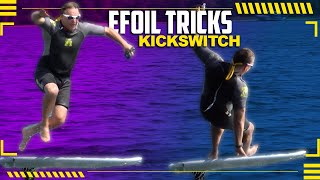
Stance is the setting most riders never consciously choose. You copy whatever you first saw and then keep it forever. This episode takes the two real options seriously: staggered, with the front foot pressed into the forward heel side corner and the back foot toe grazing the rail, against midline, with both feet centred and shoulder width apart. It follows a month of deliberately riding midline, prompted by conversations with Justin Chait, the reigning eFoil World Cup champion, who rides midline almost exclusively.
Why staggered was the starting position
Three arguments made the case for staggered originally, and they still stand here. It gives you a guaranteed bail direction, forward or backward, so your body clears the foil instead of folding over the mast onto the wing. It lets you drive the front knee forward and the back knee back independently, which is how you dial in rail angle in a hard carve. And the fore and aft weight spread keeps you upright when a swell or a wake arrives.
What midline actually gives you
The upsides showed up immediately. Carving becomes almost effortless: lean the hips and shoulders, add a little ankle roll, and the board arcs without you wrestling it. Joint strain drops sharply, because with your mass stacked over the foil the work moves from knee torque to ankle and hip flexion, which matters if your knees are already worn out. And linked S turns start to flow, one carve springing into the next rail to rail rather than each turn being negotiated from scratch. That rhythm is the addictive part.
The three things that bite back
The costs are real. First, you lose fine control: with both feet centred, corrections come only from toes and heels, so hitting weed or turbulence mid carve leaves you with no knee drive to save it. Second, bails get worse. With your feet together there is nothing between you and the wing but a jump, whereas a staggered rider can angle a fall away from the foil. Third, midline lacks leverage for race pace corrections and pumping through chop. There is a balance point to it too, so fine that carrying a camera on a stick was enough to unsettle otherwise clean turns, which tells you what shifting wind or current will do.
Who should try it
Midline suits experienced riders who have already drilled their staggered bail until it is instinct, and who have the foil feel to correct a small tilt with ankles and hips alone. Beginners should stay staggered until it is as natural as breathing. Racers and downwinders need staggered leverage. Riders with stiff ankles will struggle on toe side turns even though their knees will thank them. The conclusion after the experiment is that staggered still wins for unpredictable water, but midline is worth learning for what it teaches you about your core and ankles.
Chapters
- 0:45 Quick refresher: staggered = safer bail-outs (front foot corner / back foot rail)
- 1:36 ⚡ Benefit #1: effortless deep carves—no knee-torque wrestling
- 2:28 ⚡ Benefit #2: joint-friendly ankle steering (goodbye sore knees)
- 3:18 ⚡ Benefit #3: rhythm mode—chaining S-turns like a slalom skier
- 4:25 🚨 Drawback #1: less micro-control (only toes & heels)
- 4:57 🚨 Drawback #2: taco-fold risk—wing strike if you bail wrong
- 5:35 🚨 Drawback #3: race-mode lag—harder to punch out fast corrections
- 6:40 Who should test midline (and who absolutely should NOT)
- 8:00 Conclusion COMMENT CALL—share your stance wins, fails, or scars 🤕
- 9:20 Out takes from the recording booth
Subscribe on YouTube Every episode
Keep watching



Read more on this
- Sorting Garbage and Filtering NoiseAug 25, 2026
- Efoil Propulsion TypesJul 20, 2026
- Help Docs – Lift Battery CodesJun 21, 2026