
17 July 202531:502,432 views on YouTubeWatch on YouTube
The Integrity Trials open with the board a lot of riders have been arguing about. The Flite Ultra L2 gets a full session on the water, run against a Lift4 Pro with hundreds of hours on it, and the question is not which board wins. It is which rider each board is actually for.
The configuration on test, and what it costs
The setup here is an Ultra L2 with an 80cm Jet 2 conical drive, the Sport battery, a Wave 1000 C front wing, a Flow 245 C rear stabiliser, the standard controller and the slow charger. As configured that is 14,480 dollars at retail. The jet drive is worth flagging early, because it is not the ideal basis for a like for like comparison against a fixed prop, and it shapes several of the criticisms that follow. Weights were checked on a scale rather than taken from spec sheets, and the board comes in around fourteen pounds, with a ride ready total a little under 53 pounds.
Why the low weight changes everything
Lightness is the whole personality of this board. Heavier boards have inertia that quietly stabilises pitch and tilt for you. The Ultra L2 does not, so every bit of counterbalance has to come from the rider. A small hop takes it from an inch off the water to full altitude instantly. Gun the throttle without walking forward and it will happily flip backwards, which is why the grip pad runs almost to the nose and why racers ride so far forward they look close to hanging ten. The narrow deck also forces a midline stance from the first minute rather than easing in from a staggered one. All of that adds up to a board that responds in a fraction of the time other boards take, which is exactly what a technical rider wants and exactly what will overwhelm a beginner. It is not an intermediate board either, and with no rail handles it is a poor fit as the single board for a family with mixed abilities.
Digital versus analogue: the feel difference
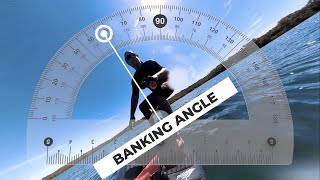
The Ultra L2 feels digital where a Lift feels analogue. The motor is louder and higher pitched, and the throttle throw is shorter, which makes speed control closer to faster or slower than to the fine gradation a longer throw gives you. Banking, the board locks into an angle of attack and holds it firmly to the end of the carve, precise but with less of the natural rhythm Lift’s wings offer. The real limitation on the course is torque: through a steep banked turn the jet cannot hold the carve the way a fixed prop can. Breaching, on the other hand, is rare, because the prop sits low on the mast and the stabiliser lower still, so the stabiliser stays wetted and re entry is easy.
Slalom times and battery life
After about half an hour of familiarisation, the slalom run came in around 42 seconds, within a couple of seconds of a personal best set on a course run countless times on the Lift4 Pro. Range was the other surprise. The ride was still showing roughly a third of the pack at 38 minutes and ran on to around 48 minutes before fatigue and fading thrust ended it, against a typical 28 to 30 minutes on the Lift setup. As the pack drains, the already modest torque drops further and sharp turns get harder to hold.
New to eFoiling? Start with what an eFoil is, how it works and what it costs.
Subscribe on YouTube Every episode
Keep watching



Read more on this
- eFoil Lake Powell YouTube Channel ReviewFeb 18, 2026
- Verdant Ride Launches: The Complete eFoil Resource HubSep 2, 2026
- Sorting Garbage and Filtering NoiseAug 25, 2026