
10 June 20263:25522 views on YouTubeWatch on YouTube
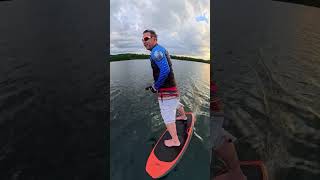
If you are trying to work out what to put under a LiftX for carving rather than straight line speed, this is a session built to answer exactly that, filmed on Lake Superior as one continuous flow ride.
The combination being ridden
The board is a LiftX in the 4’8″ size, fitted with the Lift5 mast and motor, running a 160 Camber Pro front wing with a 36 Glide rear. That pairing is the current favourite here for aggressive carving on freshwater lakes, and the parts make sense together: a cambered front wing of that size produces lift early and holds pressure through a loaded turn, while the small glide stabiliser keeps the tail settled enough that the arc stays smooth rather than nervous. Pairing it with a newer mast and motor is what makes it feel powerful rather than merely comfortable.
Telemetry on the footage
The edit carries a full GPX telemetry overlay showing speed, altitude, elevation and the path being tracked. That turns a good looking ride edit into something you can actually read as a review. Instead of taking a word for how a wing behaves, you can watch what the speed does through the entry and exit of each carve, which is the information most people are really after when they ask whether a setup rips.
Shot on a 360 drone flying its own route
Everything was filmed with a flying 360 camera running a pre-programmed Sky Path, meaning the drone flew a fixed route while the riding happened underneath and around it. The advantage over hand flying shows up in the consistency: the camera passes are repeatable, nothing has to react to the rider in the moment, and because the capture is 360, each pass can be reframed afterwards into the shot that suits the carve it caught.
New to eFoiling? Start with what an eFoil is, how it works and what it costs.
Subscribe on YouTube Every episode
Keep watching



Read more on this
- Label EverythingAug 21, 2026