
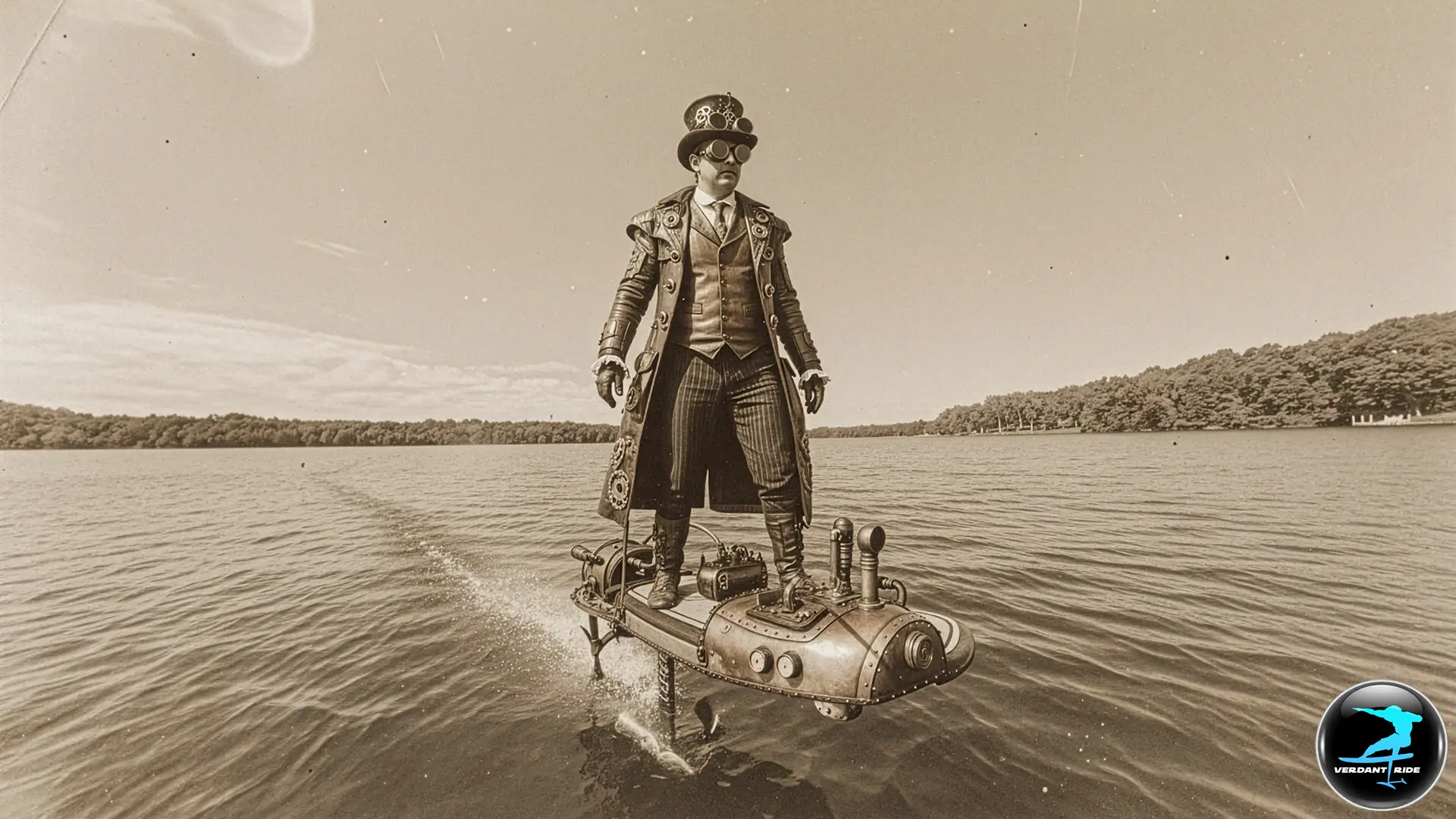

From Early Patents to Modern Electric Foils—Lift Foils (operated by MHL Custom, Inc.), Fliteboard, SiFly, and Waydoo—including discussions of patent ownership, key lawsuits, the acquisition of patent rights by MHL Custom under founder Nick Leason, and licensing arrangements.
Introduction
Hydrofoils, often described as underwater wings, enable watercraft to “fly” above the surface by generating lift as they move through water. This principle, analogous to airplane aerodynamics, minimizes hull resistance and allows for higher speeds and efficiency. The history of hydrofoils spans over 150 years, evolving from rudimentary concepts to sophisticated electric-powered personal devices. Modern eFoils, controlled primarily through the rider’s weight shifts, exemplify this progression, blending electric propulsion with hydrofoil technology for recreational use.
Early Patents and Inventors
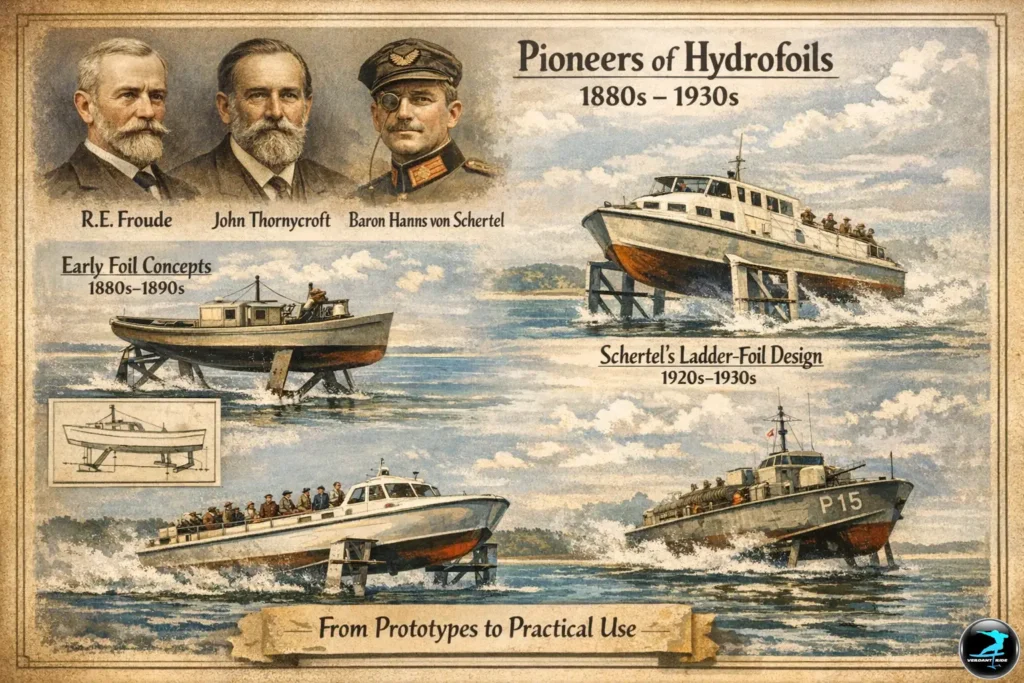
The conceptual foundations of hydrofoils date to the mid-19th century. The first documented patent for a hydrofoil-equipped vessel was granted in 1869 to Emmanuel Denis Farcot, a Parisian inventor. Farcot’s British patent described a rowing boat with inclined planes or wedges attached to its sides and underside, designed to lift the vessel and reduce draught during motion. While it is unclear if Farcot ever built a functional prototype, his work laid the groundwork for future developments.
Significant progress occurred at the turn of the 20th century. In 1898, Italian engineer Enrico Forlanini began experimenting with hydrofoils, patenting a “ladder” foil system in Britain (GB190507603A) and the United States. Forlanini’s design featured multiple stacked foils at the bow and stern of an airscrew-driven boat. By 1906, he tested a prototype on Lake Maggiore, achieving speeds of 68 km/h (approximately 37 knots). Forlanini’s innovations attracted aviation pioneers, including the Wright Brothers, who recognized the parallels between hydrofoils and aircraft wings.
In 1908, telephone inventor Alexander Graham Bell, collaborating with engineer Frederick “Casey” Baldwin, initiated hydrofoil experiments in Canada. Inspired by Forlanini’s work—after riding his boat on Lake Maggiore in 1910-1911—Bell and Baldwin developed the HD-4, a five-ton vessel powered by two 350 hp Liberty aircraft engines. In 1919, the HD-4 reached 114 km/h (61.5 knots), setting a world marine speed record that stood for a generation.
Early Testing and Commercial Applications
Early testing focused on overcoming stability and control challenges. Forlanini’s 1906 Lake Maggiore trials proved the viability of ladder foils for speed, while Bell’s HD-4 tests highlighted scalability issues, such as foil cavitation at high velocities. In the 1930s, German engineer Günther Jörg developed surface-piercing foils, leading to the first commercial hydrofoil ferry in 1952: the PT10 “Freccia d’Oro” by Supramar, operating on Lake Maggiore between Switzerland and Italy. This vessel carried 32 passengers at 35 knots, marking hydrofoils’ entry into public transport.
The 1950s-1960s saw widespread adoption. In 1956, the Canadian Navy tested the R-103, a collaboration with Britain’s Saunders-Roe, achieving 50 knots. Commercial ferries proliferated in Europe and the Soviet Union, with models like the Raketa (1957) serving rivers and coastal routes. By the 1970s, hydrofoils were used in over 20 countries, with Boeing’s Jetfoil (1974) exemplifying advanced designs featuring fully submerged foils and gas turbine propulsion for 45-knot speeds.
Flying Over Water Before Planes Were Even a Thing: The Wild, Wet, Patent-Punch-Up History of eFoiling – From 1869 Pipe Dreams to Today’s Silent, Zero-Emission Magic Carpets
Listen up, water warriors and planet protectors: Imagine telling a bearded Victorian inventor in 1869 that one day regular humans would stand on a board, shift their weight like they’re snowboarding powder, and fly silently over flat water at 25+ mph with zero exhaust, zero wake damage, and zero excuses not to get outside. He’d laugh, call you daft, and probably patent it first.
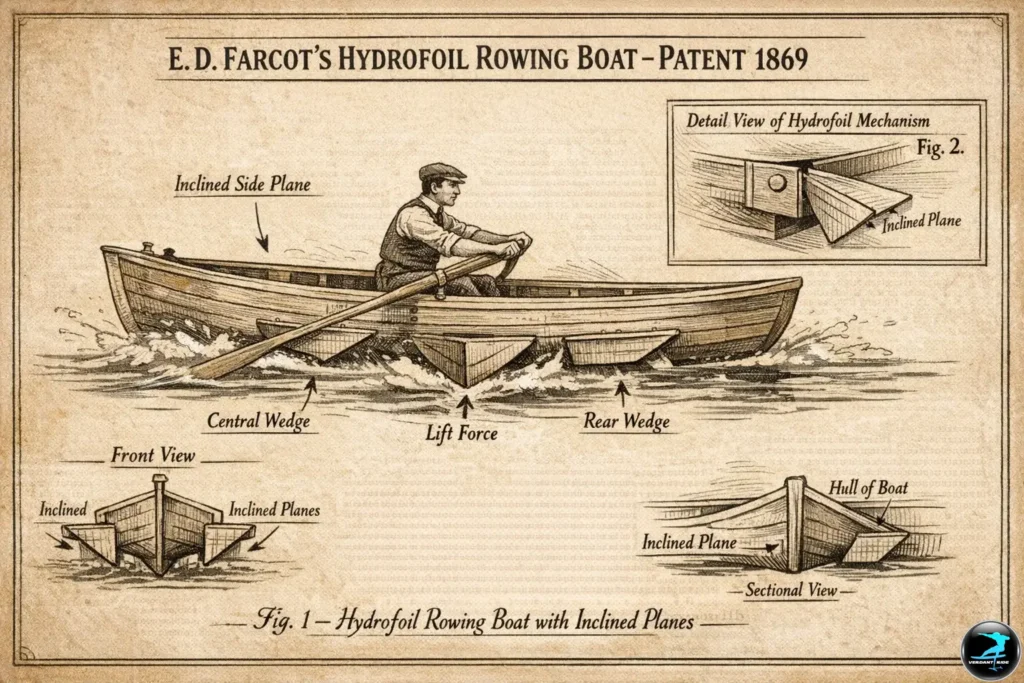
First documented patent for a hydrofoil-equipped vessel – 1869, Emmanuel Denis Farcot
Fast-forward to 2026, and eFoiling is the most sustainable, grin-inducing watersport on Earth — quiet enough to hear the fish gossip, clean enough that lakes thank you, and addictive enough that your first successful takeoff feels like cheating gravity.
At VerdantRide, we’re obsessed with clean thrills that leave the planet happier, so buckle your (virtual) helmet for the full, hilarious, deeply researched saga of hydrofoils turning into eFoils. Patent lawsuits included. Because nothing says “innovation” like lawyers, jury verdicts, and boards that make you feel like a superhero who forgot the cape.
Insert Image 1 here (hero image – large):
Early 1900s hydrofoil boat (Forlanini 1906 ladder-foil on Lake Maggiore – black & white historical photo)
1869–1919: The Victorian “What If We Just Make the Water Jealous?” Era
Parisian mad lad Emmanuel Denis Farcot kicks it off in 1869 with the world’s first hydrofoil patent: slap inclined planes (basically underwater wings) under a rowing boat, go fast, and watch it lift like it’s too fancy for drag.
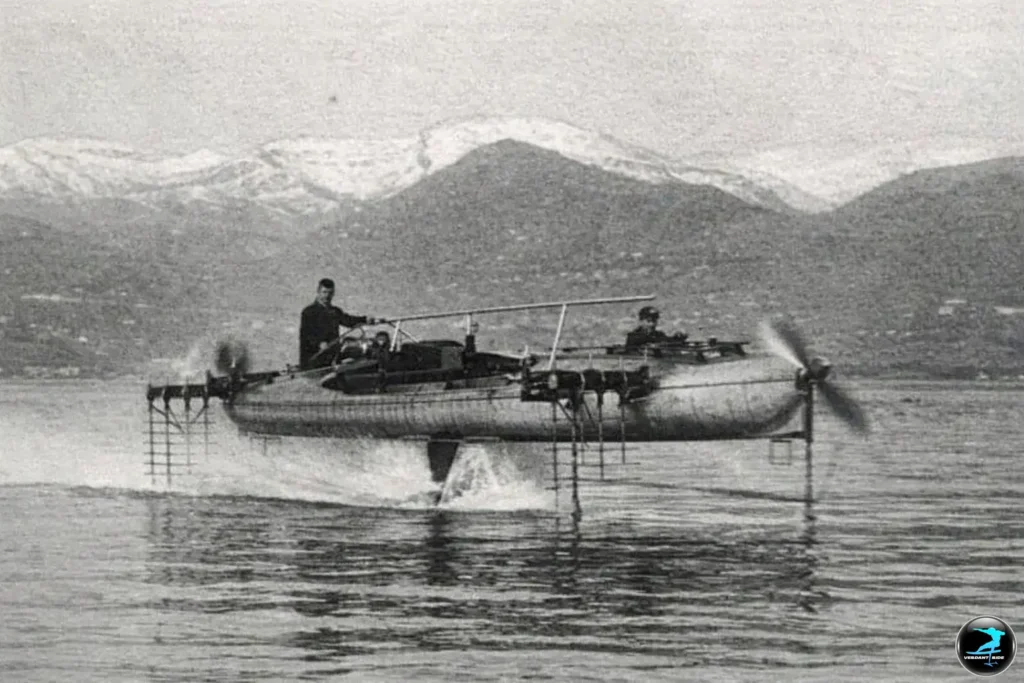
Ladder hydrofoil – 1898, Enrico Forlanini’s hydrofoil on Lake Maggiore
Enter Italian engineer Enrico Forlanini in 1906. This guy actually makes it work — ladder-style foils on a 60 hp airscrew boat hitting 36.9 knots (68 km/h). Picture a steampunk gondola on stilts screaming across the water.
Not to be outdone, Alexander Graham Bell teams up with Casey Baldwin. Their HD-4 smashes the water-speed record at 70.86 mph (114 km/h) in 1919. These early beasts were loud, gas-guzzling, military-grade flexes — but they proved the physics: lift + speed = pure water wizardry.
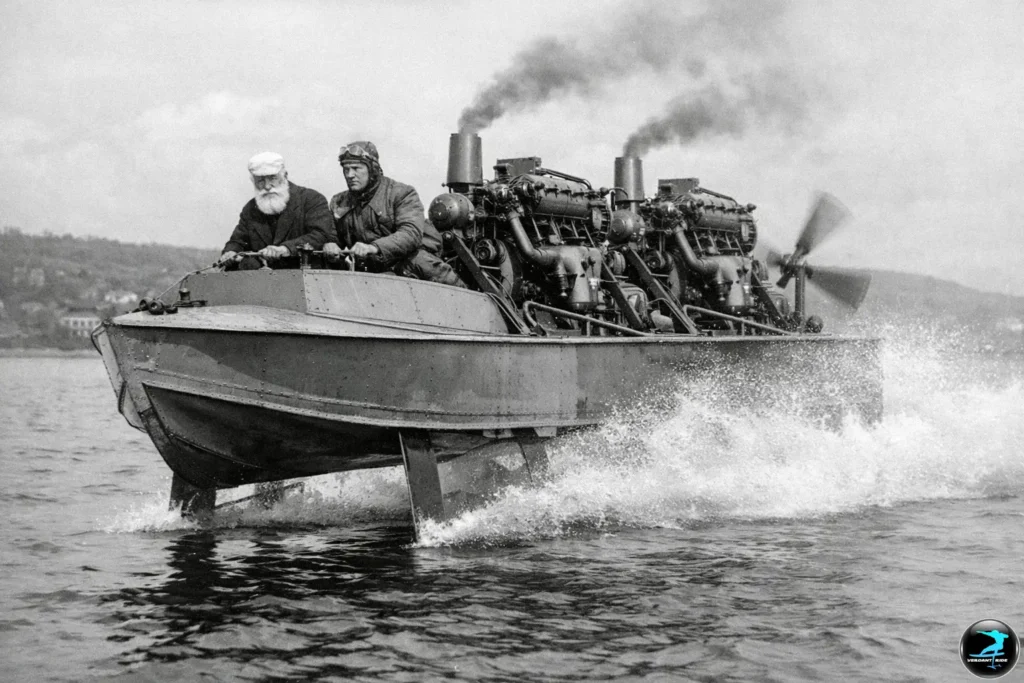
The Royal Canadian Navy’s HMCS Patriot towing the HD-4 hydrofoil designed by Dr. Alexander Graham Bell and F.W. (Casey) Baldwin, 1964
Early hydrofoil pioneers solved stability and speed challenges, leading to the first commercial ferry in 1952, Supramar’s 32 passenger PT10 “Freccia d’Oro,” operating at 35 knots on Lake Maggiore.
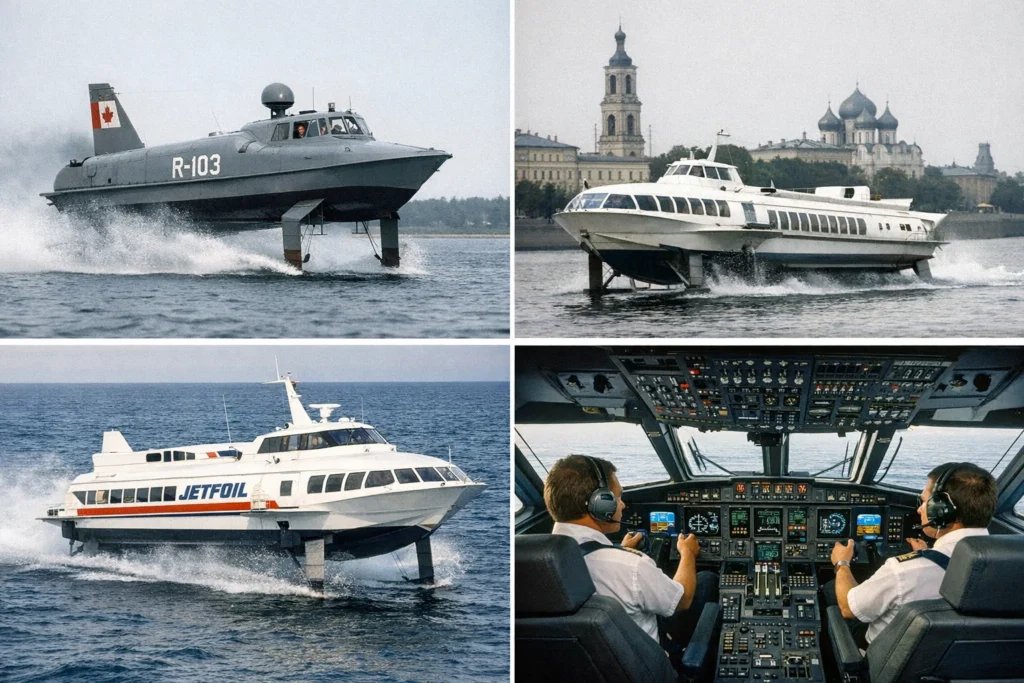
Hydrofoils then went pro: military experiments, passenger ferries, and eventually revolutionized sailing in the America’s Cup. The dream was alive… but noisy and thirsty.
2009: The Swedish Spark That Lit the Electric Fuse
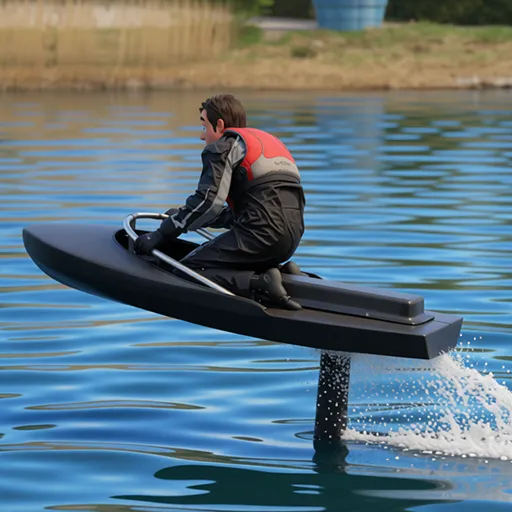
Swedish engineering students and professors at KTH Stockholm build the Evolo — the world’s first documented electric, weight-shift-controlled hydrofoil surfboard. Passive stability, rider leans to steer, electric motor, zero emissions. It’s basically the blueprint for every modern eFoil.
2013–2018: The Patent That Launched (and Later Sued) an Industry
Penn State professor Jack W. Langelaan files the core patents in 2013: U.S. Nos. 9,359,044 and 9,586,659. They cover passively stable, weight-shift steered personal electric hydrofoils — exactly what we ride today.
In 2016, MHL Custom, Inc. (parent of Lift Foils, founded by Nick and Michael Leason in Puerto Rico) secures exclusive rights. Lift drops the first commercial eFoil in 2018 and the watersport world loses its collective mind.
The Great eFoil Patent Drama: 2021–2025 (Cue the Courtroom Popcorn)
MHL Custom enforces the patents aggressively. To sell weight-shift steerable eFoils in the U.S. without drama, competitors must license from MHL Custom, Inc.
Exact royalty rates are confidential, but court documents reveal:
- Reasonable royalty found by jury = $500 per board
- Fliteboard’s 2019 non-exclusive license was used as a comparable in court
Waydoo (affordable Chinese Flyer series) gets sued in Delaware federal court (1:21-cv-00091) in 2021.
March 2023 jury: willful infringement on 2,668 boards sold in the U.S. → $1,334,000 damages.
Full settlement 2024–early 2025: Waydoo pays damages and agrees to ongoing royalties to keep selling legally.

Fliteboard, Awake, FOIL, and BRP (Sea-Doo) all license cleanly from MHL and stay out of court.
SiFly (Stellar/Max Plus/Master series — $4,899–$9,999, 45-minute runtime, modular, 200+ own patents) entered the U.S. market smoothly with zero public lawsuits — meaning they’re either quietly licensed with MHL or have clever design-arounds. Either way, they’re the people’s champion for accessible, sustainable flying.

Why This Drama Actually Made eFoiling Better (and Greener)
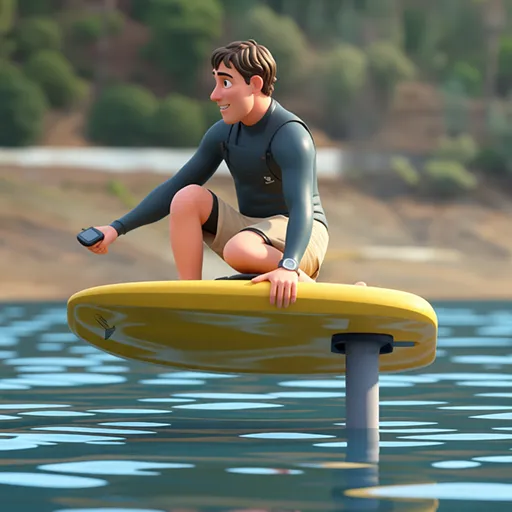
Broad patents sparked debate, but they forced the industry to level up: safer flight controllers, better batteries, modular designs, and — most importantly — zero-emission everything. No gas. Minimal wake. Rideable on ponds, lakes, rivers, or calm ocean. 45+ minutes of silent flight per charge. Beginner-friendly yet pro-addictive.
VerdantRide exists for exactly this: curating the best licensed, sustainable eFoils so you can fly clean without worrying about the legal fine print.
Conclusion: The Future Is Foiling… and It’s Electric
From Farcot’s 1869 scribbles to Forlanini’s ladder foils, Bell’s record runs, the Swedish Evolo spark, Lift’s commercial breakthrough, and the great MHL patent enforcement saga — hydrofoils have evolved from experimental oddities into accessible, planet-friendly magic.
The patent drama? Just another chapter in the long history of inventors protecting (and sometimes litigating) their dreams. Today the industry is stronger, safer, and more sustainable because of it.
So what are you waiting for? The water’s calling — and it’s never been quieter or cleaner. Grab an eFoil, leave the planet smiling, and come tell us your first-flight story.
VerdantRide – Where clean waters meet cleaner thrills.
References
Patents
- Forlanini, E. (1905). Improvements in or appertaining to Apparatus for Travelling Above the Surface of Water. British Patent GB190507603A (filed 1905, granted 1906). https://patents.google.com/patent/GB190507603A
- Langelaan, J.W. (2014). Weight-shift controlled personal hydrofoil watercraft. U.S. Patent No. 9,359,044 B2 (filed 2014, granted 2016-06-07). Assignee: Individual (subsequently licensed to MHL Custom, Inc.). https://patents.google.com/patent/US9359044B2
- Langelaan, J.W. (2016). Powered hydrofoil board. U.S. Patent No. 9,586,659 B2 (filed 2016, granted 2017-03-07). Assignee: MHL Custom Inc. https://patents.google.com/patent/US9586659B2
Court Records — MHL Custom, Inc. v. Waydoo USA, Inc.
- MHL Custom, Inc. v. Waydoo USA, Inc., Civil Action No. 1:21-cv-00091-RGA (D. Del. filed Jan. 27, 2021; terminated July 1, 2024). U.S. District Court for the District of Delaware. Judge: Richard G. Andrews. Nature of Suit: 830 Patent — Patent Infringement. Full public docket via CourtListener (RECAP Archive): https://www.courtlistener.com/docket/46111479/mhl-custom-inc-v-waydoo-usa-inc/
Historical Sources & Wikipedia Articles
- Wikipedia contributors. (2024). Hydrofoil. Wikipedia, The Free Encyclopedia. Retrieved March 2026, from https://en.wikipedia.org/wiki/Hydrofoil
- Wikipedia contributors. (2024). Enrico Forlanini. Wikipedia, The Free Encyclopedia. Retrieved March 2026, from https://en.wikipedia.org/wiki/Enrico_Forlanini
- Wikipedia contributors. (2024). HD-4. Wikipedia, The Free Encyclopedia. Retrieved March 2026, from https://en.wikipedia.org/wiki/HD-4 (Bell & Baldwin’s 1919 world speed record hydrofoil)
- Wikipedia contributors. (2024). Alexander Graham Bell. Wikipedia, The Free Encyclopedia. Retrieved March 2026, from https://en.wikipedia.org/wiki/Alexander_Graham_Bell
- Wikipedia contributors. (2024). Raketa (hydrofoil). Wikipedia, The Free Encyclopedia. Retrieved March 2026, from https://en.wikipedia.org/wiki/Raketa_(hydrofoil) (Soviet commercial hydrofoil ferry, first launched 1957)
- Wikipedia contributors. (2024). Boeing 929 Jetfoil. Wikipedia, The Free Encyclopedia. Retrieved March 2026, from https://en.wikipedia.org/wiki/Boeing_929_Jetfoil (Boeing’s 1974 fully-submerged foil, gas-turbine hydrofoil)
KTH Evolo Project (First Weight-Shift Electric Hydrofoil, 2009)
- Kuttenkeuler, J. & Hallström, S. (2009). Evolo Electric Hydrofoil Surfboard Project. KTH Royal Institute of Technology (Stockholm, Sweden), Master’s Program in Naval Architecture. The Evolo was the world’s first documented passively stable, weight-shift-controlled electric hydrofoil surfboard, demonstrated in spring 2009 — the direct technical precursor to all modern eFoils. The original KTH project page is no longer publicly available. For secondary source coverage, see: Trewern, D. (Fliteboard). “Unveiling the Evolution: A Brief History of the eFoil.” https://fliteboard.com/blogs/news/unveiling-the-evolution. See also E-Surfer’s interview with Prof. Kuttenkeuler: https://e-surfer.com/en/blog/electric-foil-patents/



Leave a Reply
You must be logged in to post a comment.