
eFoil Gear Tags
Two-colour, two-sided keychain tags for every Lift Foils and Fliteboard front wing — 72 of them, current production and discontinued. Clip one to each wing bag and you know what is inside without unzipping it. Free, and yours to remix.
- 72 wings
- 2 brands
- 35 × 35 mm tag
- 2 filaments
- No supports
- Ø3 mm keyring hole
- Bambu X1C plates ready to slice
- Illustrated PDF guide
Lift Foils49 front wings, current and discontinued
Every Lift Foils front wing we could verify — 27 still sold, 22 discontinued. Same three builds, same 35 mm tag, its own catalogue and its own guide.
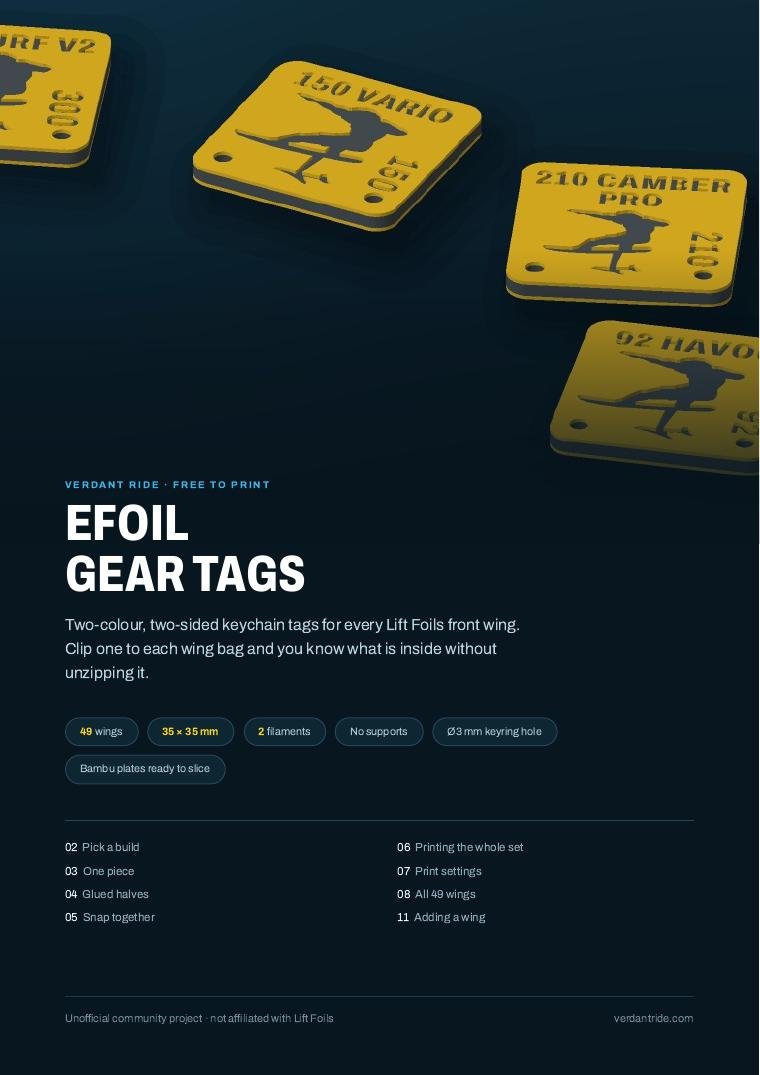
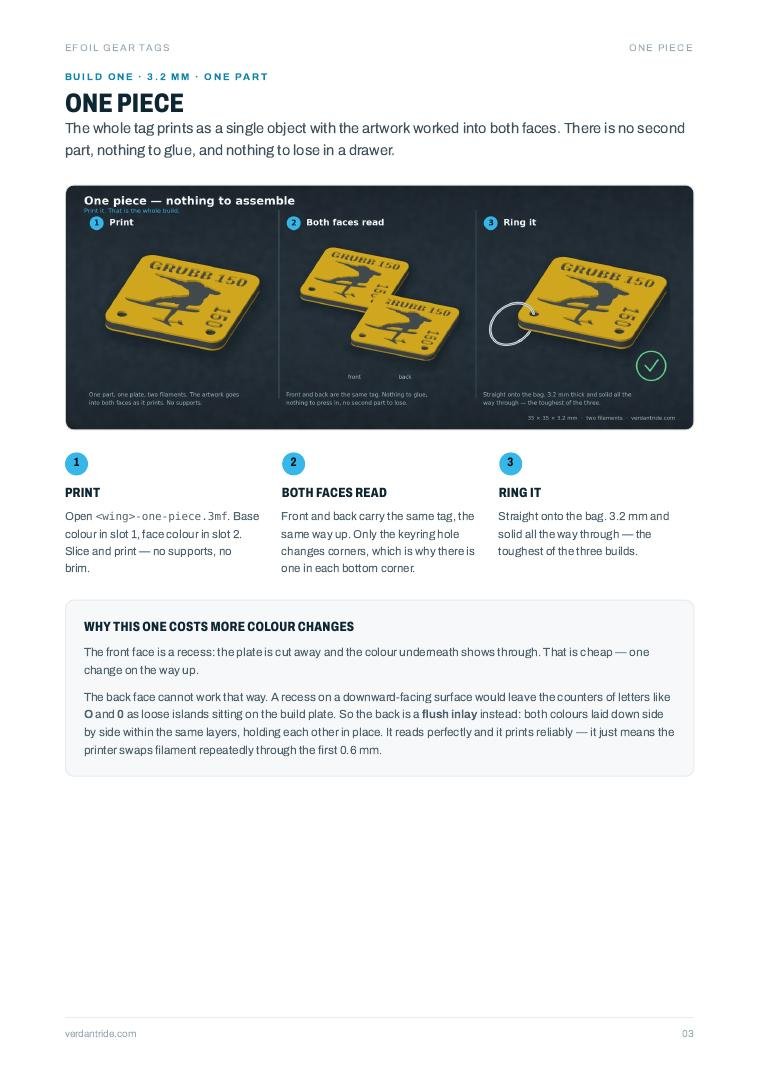
The Lift Foils guide
Eleven pages: how to choose between the three builds, step-by-step assembly for each, print settings, why trays and inserts want their own beds, and a catalogue of all 49 wings with their specs. A copy is inside every download below — this is the same file on its own.
Pick a build
Three ways to make the same tag. They look identical when they are finished — the difference is how much assembly you feel like doing. Every download has all 49 wings in it, and each “all 49 on plates” file arrives with the beds already laid out, 25 tags to a plate.
Nothing to assemble
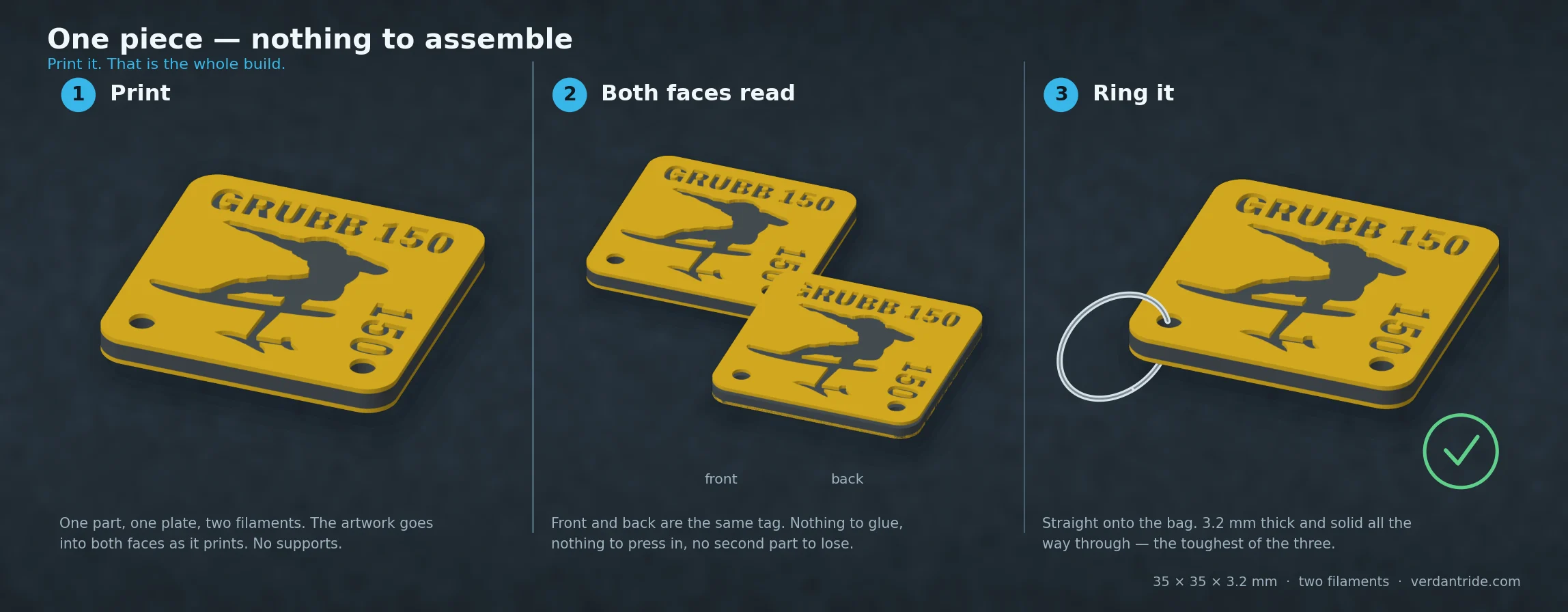
One piece
One part, one plate, artwork on both faces. Print it and clip it on. Thickest and toughest of the three; it buys that by changing colour in the first millimetre of both faces.
Fewest colour changes
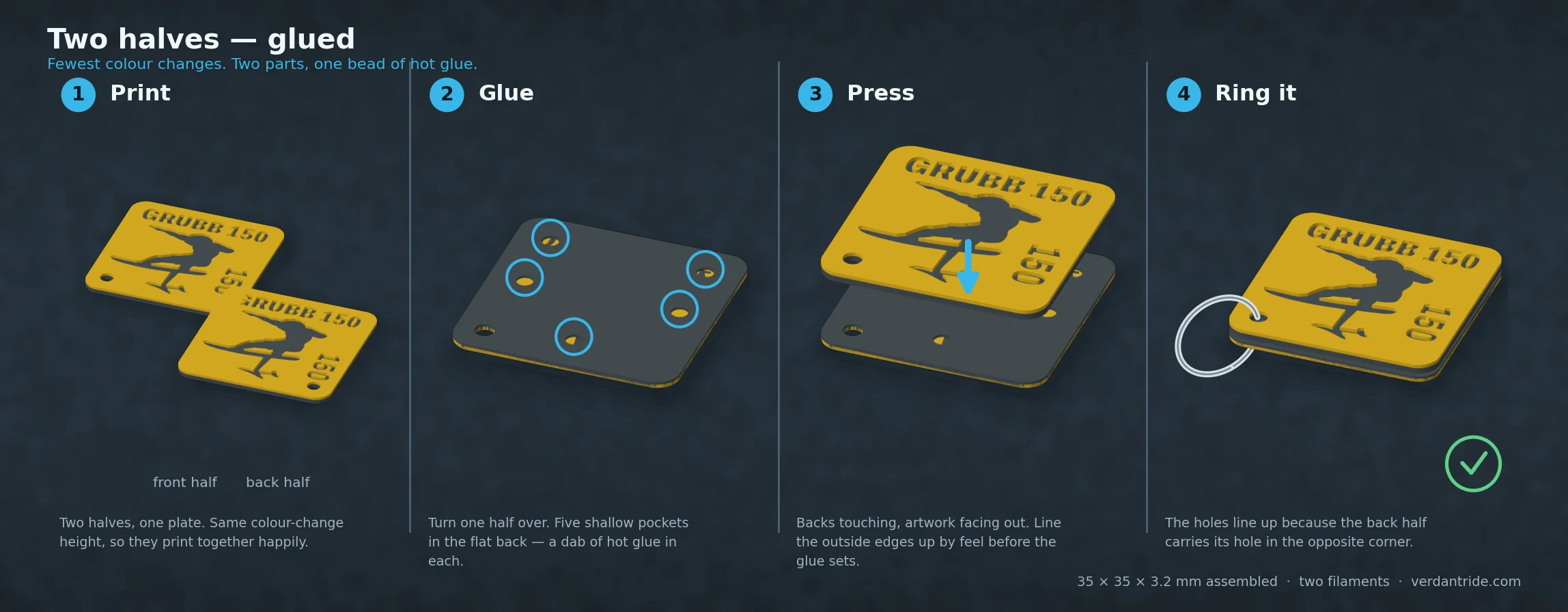
Glued halves
Two flat halves that print side by side on one plate, with five shallow glue pockets in each flat back. A dab of hot glue and a squeeze. Fastest to print of the three — start here if you are not sure.
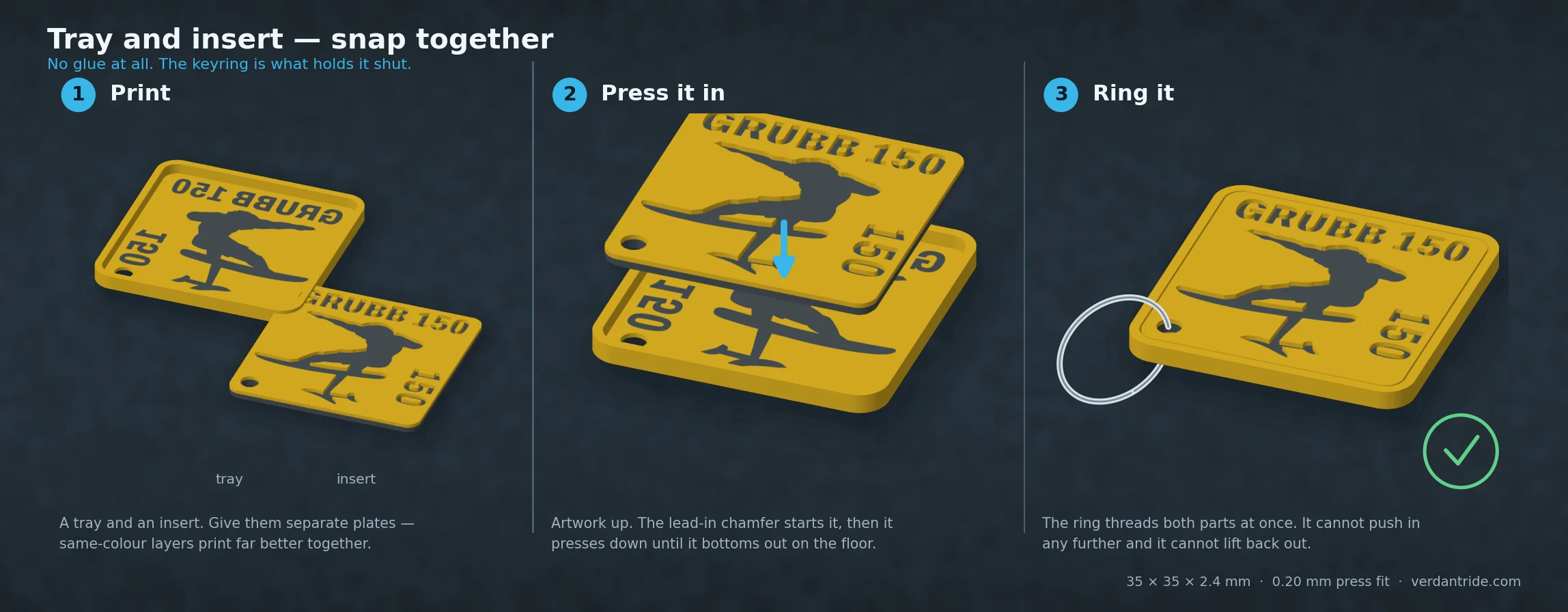
No glue at all
Snap together
A tray and an insert with a 0.20 mm press fit. The insert bottoms out on the tray floor, and the keyring threads both parts so it cannot come apart. Thinnest of the three and the cleanest edge.
Every Lift Foils wing in the set
Specs are from liftfoils.com and dealer listings. A few are blank because Lift never published them. The tags themselves carry only the model name and the size number.
Vario6
Havoc8
Kaikea2
High Aspect5
High Aspect X4
Surf V27
Camber Pro5
Florence4
Grubb1
Classic4
Surf V13
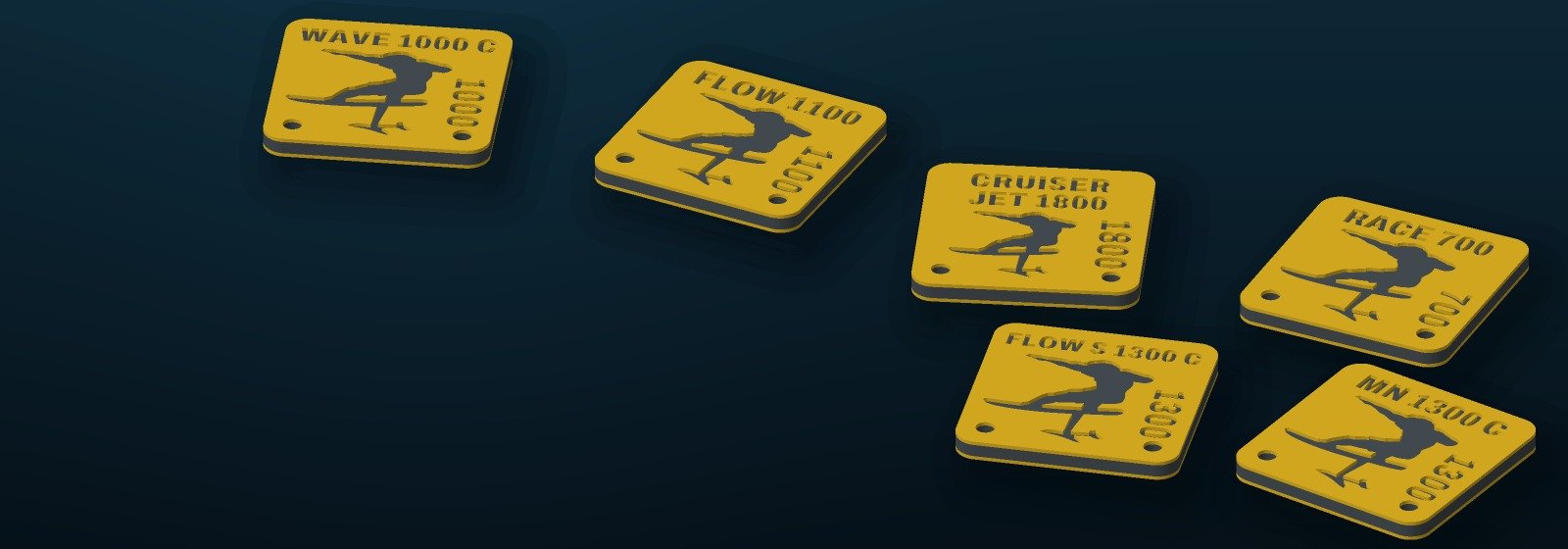
Fliteboard23 front wings, current and discontinued
Every Fliteboard front wing we could verify — 18 still sold, 5 discontinued. Same three builds, same 35 mm tag, its own catalogue and its own guide.
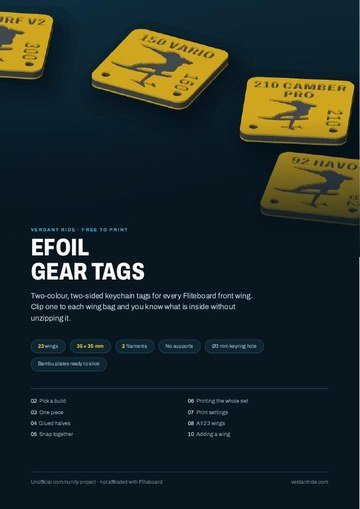
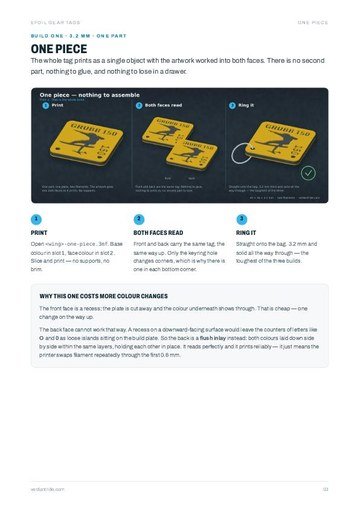
The Fliteboard guide
Ten pages: how to choose between the three builds, step-by-step assembly for each, print settings, why trays and inserts want their own beds, and a catalogue of all 23 wings with their specs. A copy is inside every download below — this is the same file on its own.
Pick a build
Three ways to make the same tag. They look identical when they are finished — the difference is how much assembly you feel like doing. Every download has all 23 wings in it, and each “all 23 on plates” file arrives with the beds already laid out, 25 tags to a plate.
Nothing to assemble
One piece
One part, one plate, artwork on both faces. Print it and clip it on. Thickest and toughest of the three; it buys that by changing colour in the first millimetre of both faces.
Fewest colour changes
Glued halves
Two flat halves that print side by side on one plate, with five shallow glue pockets in each flat back. A dab of hot glue and a squeeze. Fastest to print of the three — start here if you are not sure.
No glue at all
Snap together
A tray and an insert with a 0.20 mm press fit. The insert bottoms out on the tray floor, and the keyring threads both parts so it cannot come apart. Thinnest of the three and the cleanest edge.
Every Fliteboard wing in the set
Flite publishes no specs on its product pages — these come from its range page, where some blocks cover two wings at once. A few are blank where the published figures contradict each other. The tags themselves carry only the model name and the size number.
Cruiser2
Cruiser Jet3
Flow5
Flow S5
MN1
Race1
Wave2
FLUX3
Flyer1
Before you slice
Why trays and inserts get their own beds
A snap tray changes colour at 0.6 mm; its insert changes at 1.2 mm. Put both on one plate and the printer swaps filament on nearly every layer for the first millimetre and a half. Keep parts with the same colour-change height together and a whole plate of 25 costs two changes.
That is why every snap download splits trays and inserts onto separate plates. The glued halves have identical profiles, so they share.
Colours and nozzle
Base colour in slot 1, face colour in slot 2. The original is grey behind yellow, but any pair works — go dark behind light or light behind dark so the text pops.
0.4 mm nozzle. The thinnest feature in the logo is about 0.84 mm, which is two extrusions at 0.4; a 0.6 mm nozzle starts losing the mast and the foil.
Other slicers, or one colour
The 3MFs open in Bambu Studio, OrcaSlicer and PrusaSlicer with both colours already assigned. Anywhere else, grab the STL download for your build and add the filament change by hand — the guide in each ZIP lists the exact height.
Printed in a single colour it still reads: the front artwork is a 0.6 mm engrave.
A wing that is not here?
The whole set is generated by a Python script driven by a CSV — no CAD, no dragging shapes around. Add a line, run it, and you have all three builds for the new wing, whichever brand it belongs to.
Free to print, remix and share. Sell prints if you like. A link back is appreciated, not required. Typeface is Archivo Condensed ExtraBold under the SIL Open Font License.
Wings, sizes and model names are trademarks of their respective makers. This is an unofficial community project and is not affiliated with or endorsed by Lift Foils or Fliteboard.
Found a wrong spec, a missing wing, or a tag that will not print right? Tell us and we will fix it.
