

For decades, the thrill of water sports was tethered to the whims of nature. If you wanted to surf, you needed the perfect swell; if you wanted to windsurf, you needed a stiff breeze. Even the motorized alternatives—Jet Skis and WaveRunners—came with their own heavy baggage. They were loud, fuel-thirsty behemoths that required a trailer and a boat ramp just to get moving.

Then, in early 2017, a video began circulating on social media that looked less like a sport and more like a scene from a science-fiction film. A rider was gliding several feet above the water’s surface on a silent, electric-powered board. There were no waves, no wake, and no engine roar—just a sense of impossible “flight.” This was the public’s first real look at the Lift eFoil, a device that didn’t just iterate on personal watercraft; it reimagined our relationship with the water entirely.
It Started with an Aerospace Engineer, Not a Surfer
While the eFoil is now the ultimate coastal status symbol, its DNA is rooted in the laboratory. The product’s journey didn’t begin in a surfboard shop, but in the mind of Nick Leason, a mechanical engineer and champion windsurfer from Puerto Rico. Leason wasn’t just a hobbyist; he had a background in industrial wind energy at Espenall Energies. When he decided to create a self-propelled hydrofoil, he didn’t look to the beach for answers—he looked to the archives of the U.S. Patent Office.
Leason discovered that the “impossible” engineering he envisioned had already been mapped out by an aerospace expert. During his research, he stumbled upon a patent application from Professor Jack Langelaan, an aerospace engineering specialist from Penn State. Langelaan had designed a personal hydrofoil craft that was decades ahead of the recreational industry.
“Professor Langelaan’s patent application was for a personal hydrofoil watercraft and I thought what was disclosed… was really good and well-written and seemed to be many steps ahead of where I was with trying to create a similar device.”
By licensing and eventually purchasing Langelaan’s foundational IP (U.S. Patents 9,586,657 and 9,415,852), Leason’s company, Lift (operating under MHL), successfully bridged the gap between high-stakes aerospace engineering and water-based adventure.
The Power of 100 Million Views
The eFoil didn’t just enter the market; it exploded into the public consciousness through sheer viral force. In January 2017, Lift released a marketing video depicting the board in its final, functional form. The reaction was a digital tidal wave. The video pulled in 100,000 hits on Facebook almost instantly, and across platforms, total views eventually surged past the 100 million mark.
This viral success was driven by a jarring contrast in technology. A traditional personal watercraft (PWC) can weigh upwards of 400 pounds, requiring significant logistics to transport and launch. In contrast, the Lift eFoil was a silent, 65-pound modular device that could be broken down into carrying cases. For the 100 million people watching, this wasn’t just another toy—it was the birth of a new category of electric transportation.
You Can Master It in Under 20 Minutes
The greatest barrier to entry for high-performance water sports like kiteboarding or surfing has always been the brutal learning curve. Lift’s strategic masterstroke was prioritizing “passive stability,” a feature derived directly from Langelaan’s aerospace-influenced patent designs.
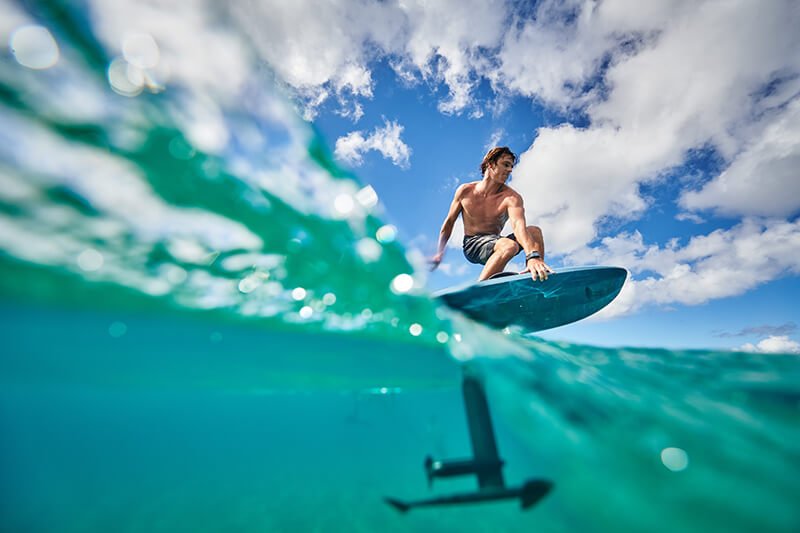
Traditional boards require a rider to make constant, frantic micro-adjustments just to stay upright. The eFoil, however, was designed with passive static stability that allows the craft to stay balanced even without rider input. By combining this stability with weight-shift control and a wireless Bluetooth hand controller for speed, Lift created an “accessible luxury” product that allows a novice to feel like a pro in the time it takes to eat lunch.
“I am confident that I could get just about anyone up and flying on one of our eFoils after 15–20 minutes of lesson time.” — Nick Leason
Creating a Market from Thin Air (and Water)
When Lift launched, they didn’t just lead the market; they held a 100% share of it. They maintained a steady, premium price point between $10,000 and $14,000, refusing to engage in a race to the bottom even as competitors emerged. Perhaps Lift’s most significant “flex” was its role as the industry’s architect; the company has successfully licensed its core patents to major competitors like Fliteboard and MSLR, proving that they don’t just sell boards—they own the underlying technology of the entire revolution.
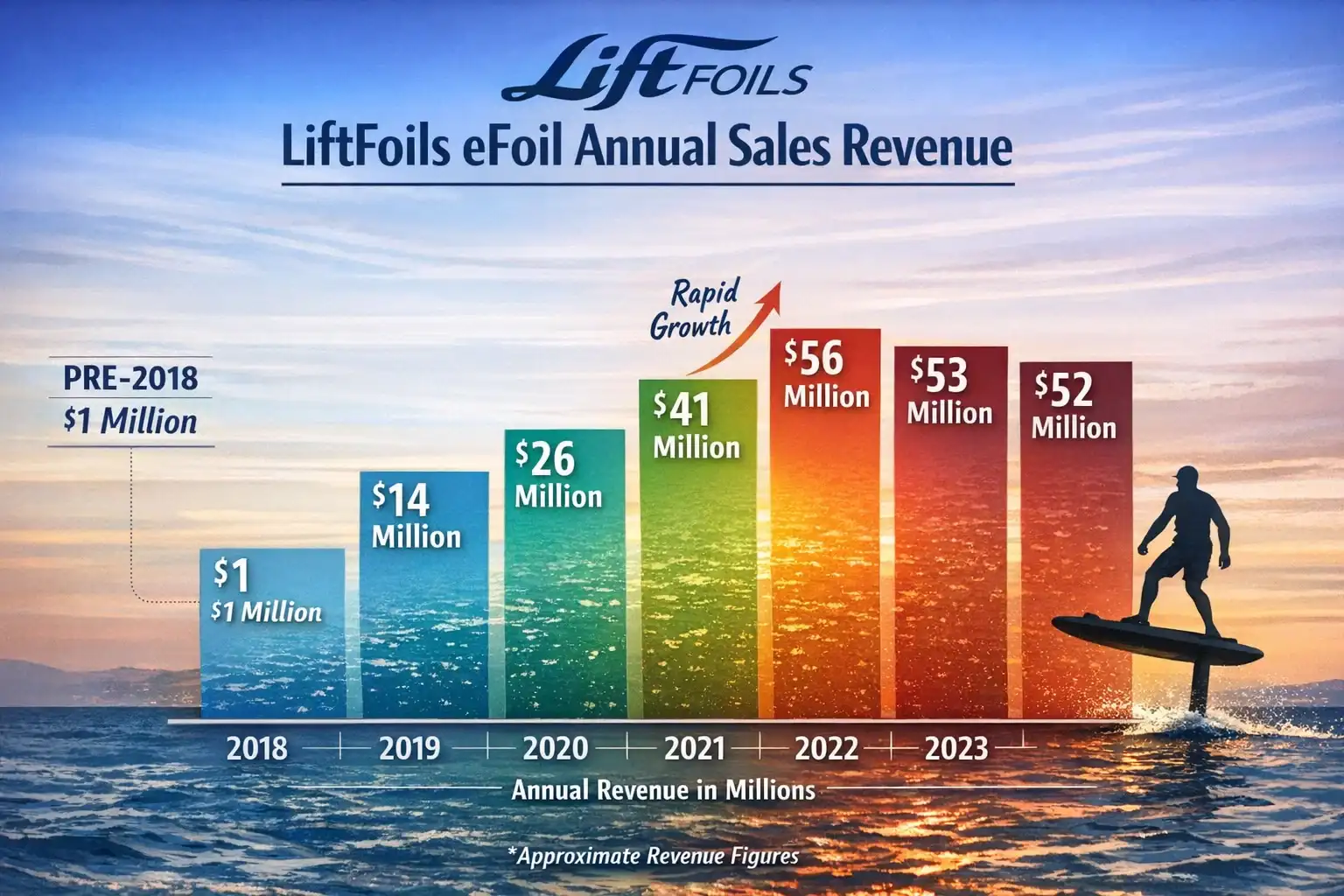
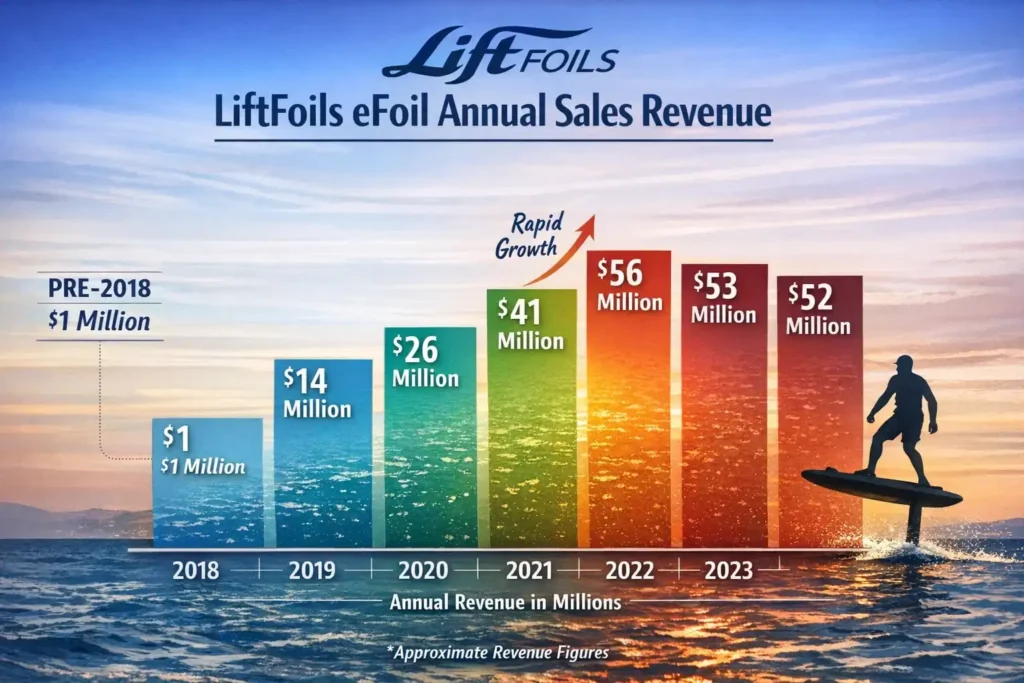
The company’s financial trajectory highlights a jump from a small-scale engineering project to a global powerhouse:
- Pre-2018: ~$1 Million (Annual revenue)
- 2018: ~$14 Million
- 2019: ~$26 Million
- 2020: ~$41 Million
- 2021: ~$56 Million
- 2022: ~$53 Million
- 2023: ~$52 Million
This growth is supported by a massive global infrastructure, with Lift boasting over 400 partners worldwide, some of whom conduct more than 1,000 lessons per year.
The “Zuckerberg Effect” and Global Media Buzz
The transition from technical prototype to global status symbol was cemented by celebrity visibility. While images of tech moguls like Mark Zuckerberg riding the device—most famously while heavily layered in sunscreen—sparked a thousand memes, the eFoil proved remarkably resilient. It survived the “PR disaster” of viral mockery to remain a must-have item for the yachting elite and Silicon Valley’s power players.
High-profile media coverage from The New York Times, Forbes, and Vanity Fair framed the eFoil as a revolutionary shift in maritime travel. It has appeared in Goop’s gift guides and “Best Toy” lists for superyachts, praised less for its specs and more for the “magical” experience it provides.
“It’s like riding a warm knife edge through butter. Suddenly you’re floating peacefully over a beautiful lake, relaxed enough to notice the surrounding trees and mountains.” — San Francisco Chronicle
Explore the Lift eFoil Lineup
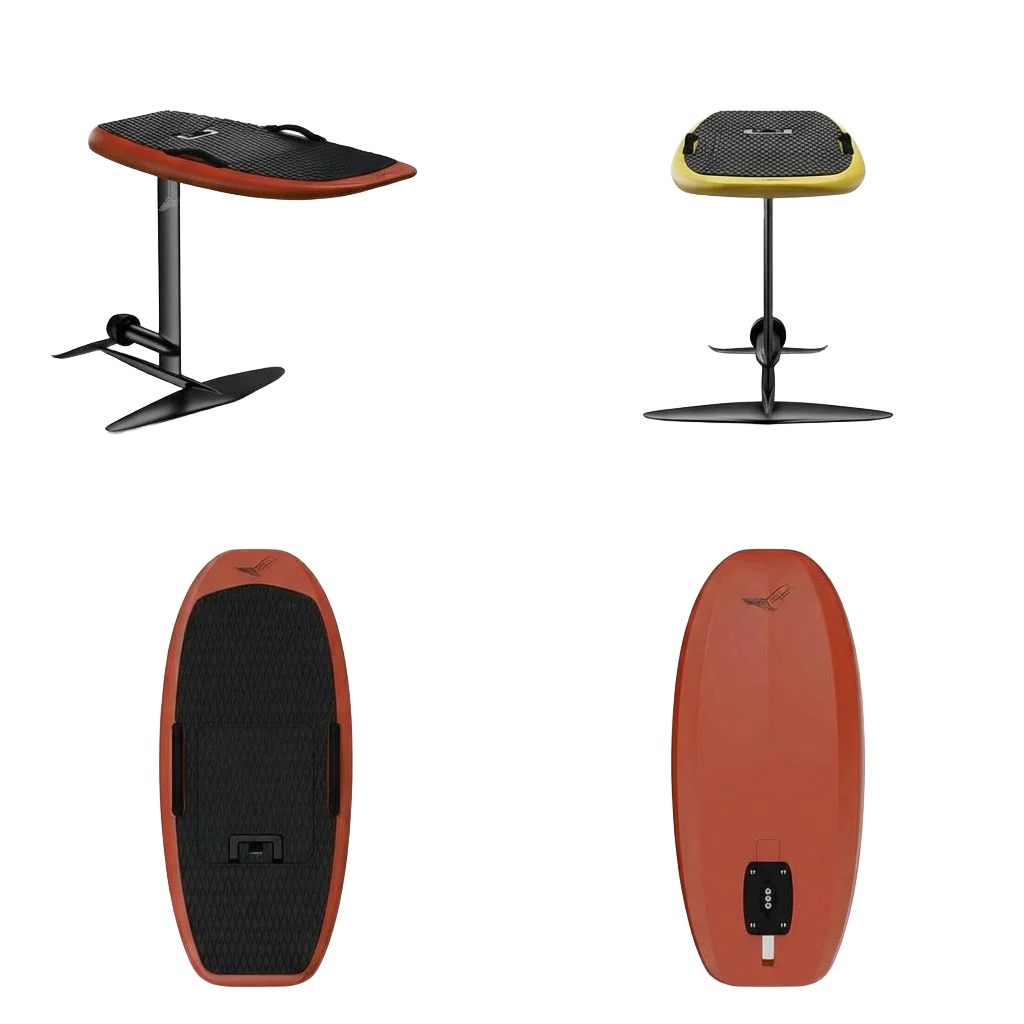
Today, Lift Foils offers several cutting-edge models designed to match every rider’s skill level and riding style:
- LIFT5 Pro eFoil – The high-performance model for experienced riders seeking speed and agility
- LIFT5 Sport eFoil – The versatile all-around board perfect for progression and fun
- LIFT5 Cruiser eFoil – The stable, easy-to-ride model ideal for beginners and relaxed cruising
- LIFT X – The next generation where surf meets powered foil
The Future is Electric and Silent
The eFoil revolution signals a broader maritime pivot. We are moving away from the era of loud, fuel-heavy, and intrusive watercraft toward a future that is electric, silent, and efficient. The hydrofoil technology pioneered by Lift is inherently sustainable; by eliminating the drag of the hull against the water, these craft require significantly less power to maintain high speeds.
As this technology matures, it raises a compelling question: Will “passive stability” remain a luxury recreation, or will it eventually redefine short-range water transportation for everyone? For now, Lift has successfully turned the dream of a magic carpet into a $50 million-a-year reality.
Ready to experience the future of water sports? Visit Lift Foils to learn more and find a demo location near you.
Sources and References
This article draws from multiple sources including patent filings, industry reports, and media coverage:
- **U.S. Patent Office** – Patents 9,586,657 and 9,415,852 for personal hydrofoil watercraft technology filed by Professor Jack Langelaan
2. **Lift Foils Official Website** – Product specifications, company history, and technical information (https://liftfoils.com)
3. **Industry Revenue Analysis** – Based on reported financial data and market analysis from water sports industry publications
4. **Media Coverage** – Referenced articles from:
- The New York Times
- – Forbes
- – Vanity Fair
- – San Francisco Chronicle
- – Goop
- 5. **Technical Documentation** – Engineering specifications and passive stability design information from Lift Foils technical materials
- – San Francisco Chronicle
- 6. **Market Research** – Global partner network data and lesson statistics from Lift Foils
- – Vanity Fair
- *Note: Revenue figures are approximate estimates based on industry analysis and publicly available information. For the most current information about Lift Foils products and specifications, please visit their official website at https://liftfoils.com*
- – Forbes




Leave a Reply
You must be logged in to post a comment.